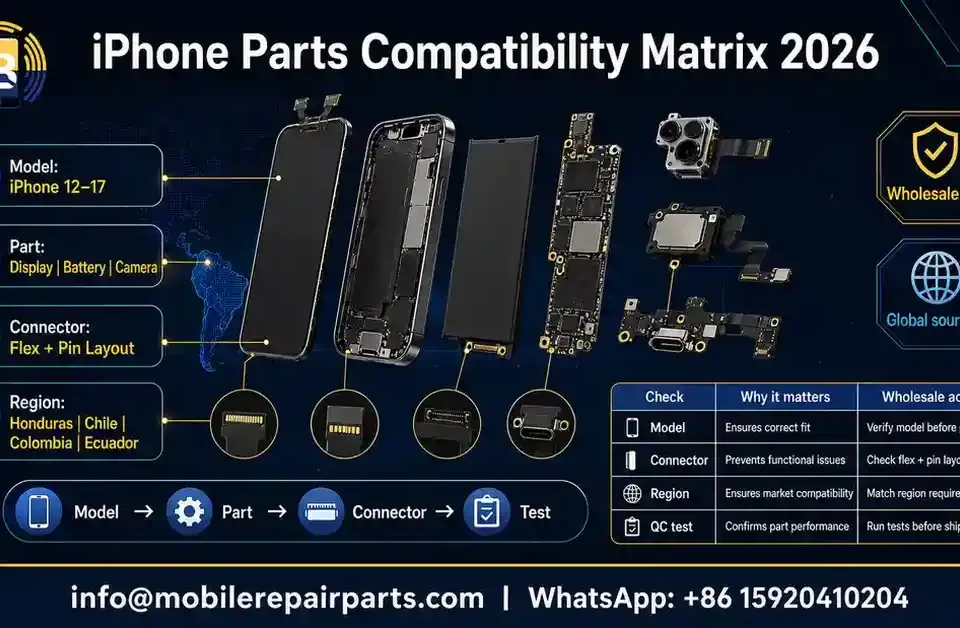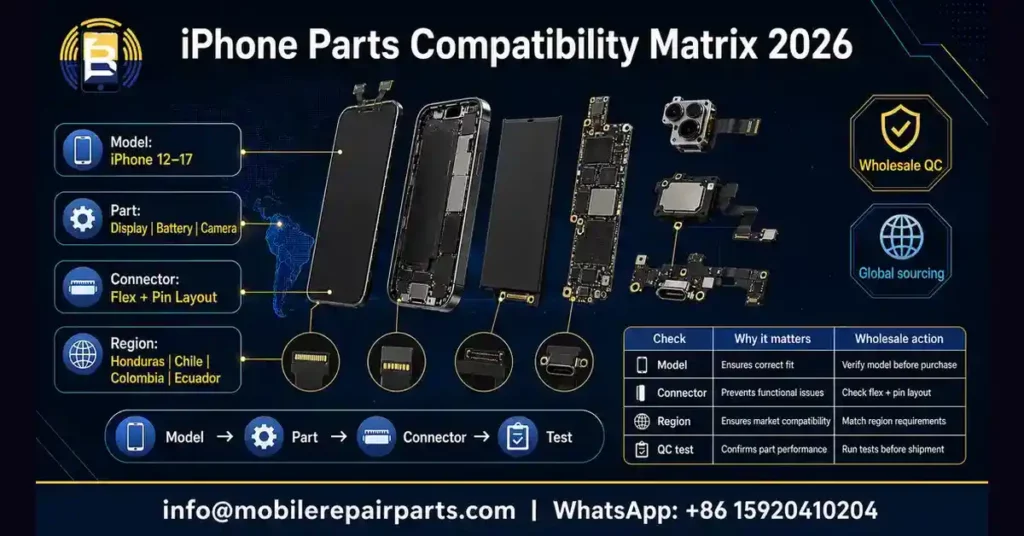



The iPhone spare parts market is a competitive one that relies on advanced components and precise technical compatibility between parts and the iOS system.
Success for wholesalers and repair technicians no longer depends solely on traditional quality ratings, but also on a clear understanding of how each component works, interacts, and integrates within the iPhone. In this guide, we’ll take you step by step through the most important and profitable iPhone parts and how to select them professionally to suit today’s market.
Table of Contents
iPhone Spare Parts System
iPhone replacement parts include all replaceable components (screens, batteries, cameras, and motherboard components). By 2026, repair was no longer merely a mechanical replacement but had become a complex software-matching process due to the following constraints:
- Part Serialization: Each part (battery, screen, camera) carries a unique serial number linked to the processor.
- Software Pairing: Features such as Face ID and True Tone require precise calibration between the iOS system and the hardware.
- Flex Cables: Precise and delicate designs that vary completely from one model to another.
- Security Authentication: Protection systems that prevent the operation of parts not certified by Apple.
Risks of Technical Incompatibility with iPhone Spare Parts
Any error in selecting or programming iPhone spare parts will immediately trigger warning messages, disable Apple features, and cause incorrect data and performance issues:
- Warning messages: A “Unknown Part” alert appears continuously.
- Feature disablement: Automatic loss of Face ID or True Tone functionality.
- Incorrect data: Battery Health percentage cannot be read.
- Performance issues: Touch instability or flickering on OLED screens.
What are the most in-demand iPhone parts in the wholesale market?
The most in-demand iPhone spare parts in the wholesale market are screens, batteries, and charging cables, as they account for the majority of daily repairs and dictate inventory trends among retailers and technicians.
| Spare Part Type | Most Common Replacement Cause | Market Demand | Key Notes for Wholesalers & Technicians |
|---|---|---|---|
| Display Assembly (OLED/LCD) | Cracks, lines, poor touch response | Very High | Highest turnover item – must stock multiple quality grades (OEM / Soft / Hard) + consider True Tone issues |
| Battery | Poor performance, swelling, fast drain | Very High | Constant demand – “Unknown Battery” warnings are common if not properly programmed |
| Rear Camera | Shaking, blur, lens damage | High | Recommend high-quality compatible versions to avoid OIS issues |
| Front Camera | Face ID failure, sensor issues | High | High risk – Use reliable, compatible, and thoroughly tested replacement parts to avoid Face ID issues |
| Charging Flex (USB-C / Lightning) | Not charging, intermittent charging | High | High-consumption item – watch for model-specific variations |
| Speakers | Low or distorted sound | Medium | Quick and easy replacement – essential for daily repairs |
| Vibration Motor (Taptic Engine) | Weak or no vibration | Medium | Lower but steady demand – often replaced alongside other repairs |
In the following sections, we will break down each iPhone spare part in detail, focusing on its market role, technical behavior, and wholesale importance in today’s repair ecosystem.
1. iPhone screen replacements
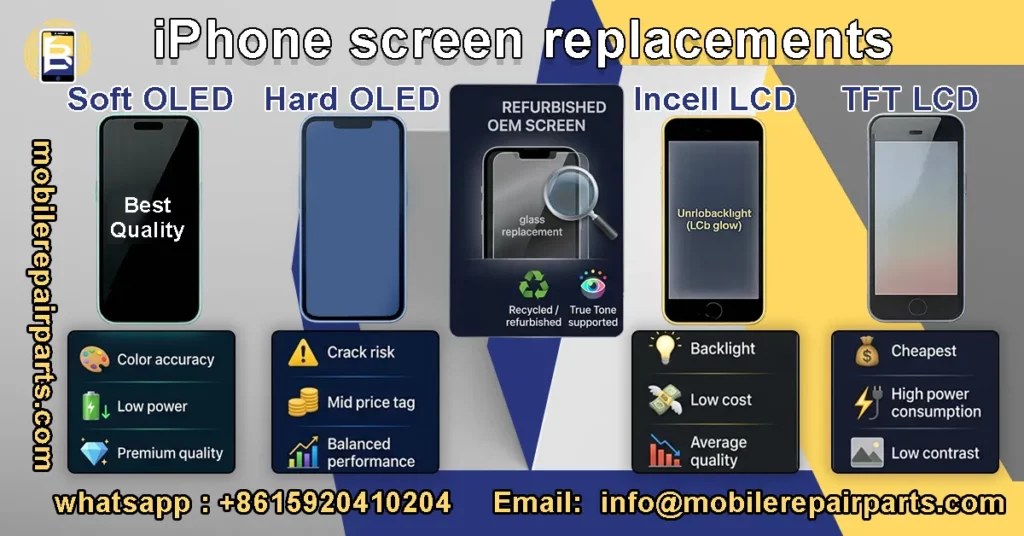
Replacement iPhone screens come in several types, including Soft OLED screens, Hard OLED screens, refurbished screens, Incell LCD screens, and TFT LCD screens.
Each type differs in terms of durability, image quality, installation risks, and wholesale profitability.
1.1 Soft OLED Screens
Soft OLED Screens are flexible OLED displays manufactured on a plastic substrate and designed to mimic Apple’s original displays in terms of performance and structure. They offer superior color quality, high brightness, and greater shock resistance compared to rigid displays, and are often used as high-quality replacements for smartphone screens.
Features of Soft OLED Screens
In the iPhone Spare Parts ecosystem, Soft OLED screens offer high flexibility and excellent display quality with low power consumption and full support for advanced features such as True Tone and IC transmission, making them the closest to the original.
| Feature | Details |
|---|---|
| Flexibility | High (plastic base reduces breakage risk) |
| Image Quality | Excellent (deep blacks, high contrast, accurate colors) |
| Power Efficiency | Optimized (extends battery life) |
| Bezels | Very thin (close to original design) |
| Compatibility | Supports True Tone and IC transfer |
Disadvantages of Soft OLED Screens
The disadvantages of Soft OLED screens include high cost, screen burn-in, and high sensitivity during installation.
- They are the most expensive option on the aftermarket.
- Screen burn-in: Permanent marks (screen burn-in) may appear on the screen when the same image or icons are displayed for a long time, such as the notification bar or app buttons, leaving a shadow visible even after the content is changed.
- Flexible OLED screens are delicate; flexible cables and solder joints can be easily damaged during improper installation.
- Transferring the integrated circuit (IC) chip requires high precision, and errors may result in “unknown component” warnings.
Why are Soft OLED screens important for wholesalers?
Because they have a low return rate, high demand, especially for flagship iPhone models (such as the iPhone 16, 16e, 16 Pro, 16 Pro Max, iPhone 17, iPhone 17 Pro and 17 Pro Max), and are preferred by professional repair shops; they also generate good profits in the long term despite their high cost.
Don’t miss out:
- Tap Into Latin America’s 40-65% Profit Margins With iPhone 15 Pro Screen.
- Why iPhone 13 Pro Max Screen Replacement Is a Tough Task.
1.2. Hard OLED Screens
Hard OLED screens use a rigid glass layer instead of flexible plastic, making them less expensive than soft OLED but less durable.
Features of Hard OLED screens
Hard OLED screens feature a rigid glass structure with good display quality and average brightness, as well as slightly thicker bezels; however, they are less durable than Soft OLED and are prone to internal cracks.
| Feature | Details |
|---|---|
| Structure | Rigid glass base |
| Image Quality | Good (slightly lower than Soft OLED) |
| Brightness | Moderate |
| Bezels | Slightly thicker |
| Durability | Lower than Soft OLED (prone to internal cracks) |
Disadvantages of Hard OLED Displays
The drawbacks of Hard OLED screens boil down to lower durability and limited display quality compared to Soft OLED:
- They are more prone to breakage or internal cracks due to the rigid glass substrate.
- Image quality is slightly lower (colors and contrast are inferior to Soft OLED).
- Thicker bezels, which reduce the screen-to-body ratio.
- Less flexible, and therefore less shock-resistant.
Why do wholesalers choose Hard OLED displays?
Because they offer a good balance between price and performance, are well-suited for price-sensitive markets, and generate quick sales and stable profit margins. Don’t miss our article: Why Hard OLED Screens Are the Best Choice.
See also:
1.3. Refurbished iPhone Screens
Refurbished screens are original Apple displays where only the broken outer glass is replaced, while the internal OLED panel, touch layer, and IC chip remain original.
Advantages of Refurbished Screens
| Feature | Details |
|---|---|
| Quality | OEM internal components |
| True Tone | Fully supported |
| Face ID Compatibility | Fully preserved |
| Visual Performance | Identical to original |
| Price | Lower than Soft OLED |
What are the technical risks associated with refurbished screens?
Any error during the replacement process may result in dust under the glass, air bubbles, or dead pixels.
- Dust under the glass: This occurs due to working in a non-cleanroom environment, resulting in permanent impurities that obstruct visibility.
- Air bubbles: These are caused by a faulty lamination machine or the use of low-quality adhesive (OCA) that begins to degrade when exposed to heat.
- Dead pixels: These appear as a result of excessive pressure or high heat during the separation of the broken glass from the sensitive OLED layer.
- Touch sensitivity issues: Sometimes the digitizer layer is damaged during cleaning, causing dead zones that do not respond to touch.
1.4. Incell LCD screens
Incell screens are screens that integrate the touch layer directly into the LCD panel, making them thinner and more responsive than older LCD technologies.
Incell screen Specifications
| Feature | Details |
|---|---|
| Technology | LCD with the touch layer integrated into the screen for better responsiveness |
| Thickness | Thinner design compared to traditional LCD screens |
| Image Quality | Moderate in terms of colors and contrast compared to OLED |
| Power Consumption | Higher because it relies on continuous backlighting |
| Compatibility | Does not fully support advanced features like OLED and True Tone |
Where Are Incell Screens Used?
Incell screens are widely used in older iPhone models such as the iPhone7, iPhone 8, iPhone 11 and iPhone SE series, as well as in mid-range repairs and for customers who prioritize price over quality.
Why are Incell screens important for wholesalers?
Incell screens play a key role in the mobile parts supply chain, especially when imported from China to developing markets. They are widely used in cost-sensitive segments because they offer low wholesale prices while still delivering acceptable performance for everyday users who are not focused on premium or high-end models.
1.5. TFT LCD screens
TFT (Thin-Film Transistor) displays are an older LCD technology used in budget smartphone screens such as iPhone SE 2016. They rely on a transistor for each pixel to deliver acceptable image quality in terms of brightness and color, but feature a separate touch layer, making them thicker and less advanced than In-Cell and OLED displays. Although it offers lower contrast and color vibrancy and consumes more power, it remains the cheapest option for low-cost repairs compared to other technologies.
A Comprehensive Comparison of Smartphone screen Types to Help Wholesalers Make Informed Decisions:
| Screen Type | Quality | Price Level | Return Rate | Best Use Case |
|---|---|---|---|---|
| Soft OLED | Excellent | High | Very Low | Premium repairs / iPhone Pro models |
| Hard OLED | Good | Medium | Medium | Balanced market demand |
| Refurbished OEM | Excellent | Medium-High | Low | OEM-quality resale |
| Incell LCD | Average | Low | Medium | Older iPhones |
| TFT LCD | Low | Very Low | High | Budget / emergency |
For a deeper comparison between OLED, Incell, and TFT iPhone screens, you can explore this detailed guide: What’s the Difference Between OLED, In-Cell, and TFT?.
2. iPhone Charging Board
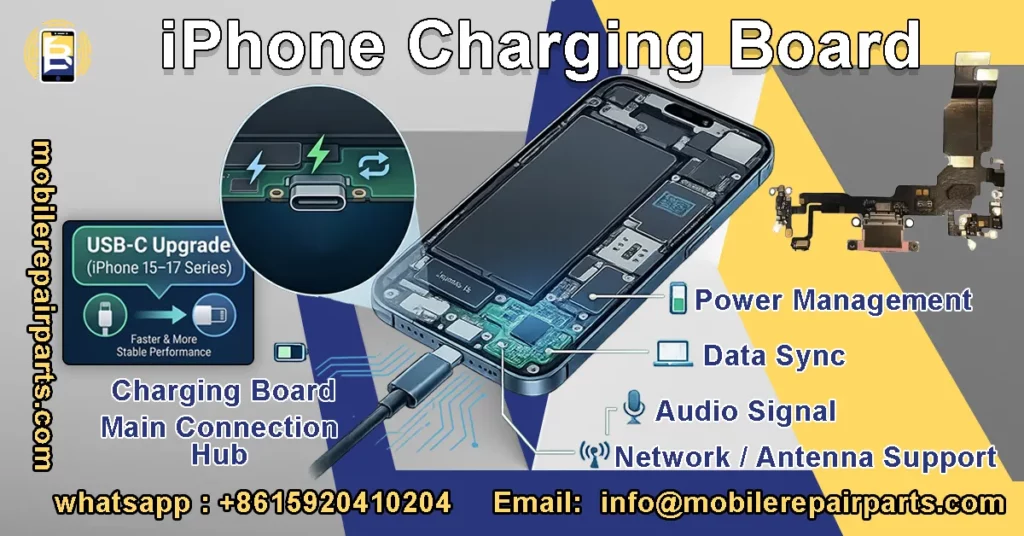
It is a vital component that integrates charging, data, microphone, and signal functions. Due to daily wear and tear and humidity, this part has become the most in-demand part in the repair market after screens, ensuring a steady income for distributors.
With the transition to the USB-C port (from the iPhone 15 to the iPhone 17 Pro Max), the importance of this component’s quality has doubled to ensure stable fast charging and efficient data transfer, as it serves as the main nerve center connecting the iPhone’s core functions.
How does the Charging Board work in modern iPhones?
In models such as iPhone 15, iPhone 15 Pro Max and iPhone 16 Plus it operates through an integrated design that combines multiple key functions, including power management, data transfer, and sometimes audio or antenna routing. Therefore, any failure in this component can cause multiple issues at the same time.
What are the most common issues caused by a damaged iPhone charging board?
When it is damaged, problems such as failure to charge, intermittent charging, the phone not being recognized by the computer, and sometimes microphone issues during calls may occur.
3. iPhone battery
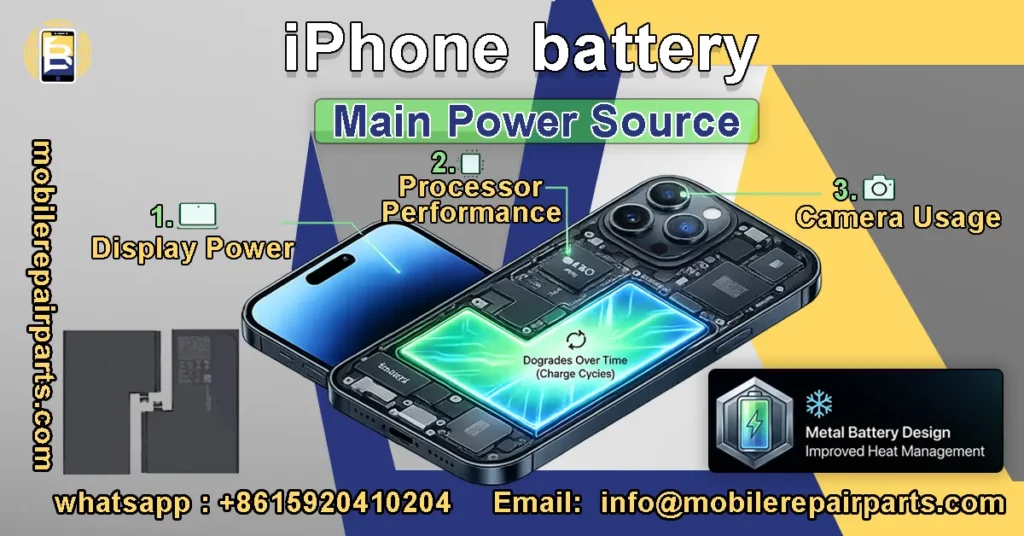
The iPhone battery is the phone’s primary power source, supplying the phone with the electricity needed to power all its components, such as the screen, processor, and camera. It is considered one of the most wear-prone parts because it gradually loses its efficiency over time due to charging cycles and daily use.
What’s new with iPhone batteries as Apple evolves its latest models?
In its latest iPhone models, such as the iPhone 16 Pro Max, iPhone 17 and iPhone 17 Pro Max, Apple has shifted toward using metal battery enclosures to improve cooling, Selecting suppliers who keep pace with these technical advancements has become essential to ensuring continued success in the spare parts market. This is exactly what BETA Electronic Co LTD offers its partners: high-quality, compatible, tested, and reliable iPhone spare parts with fast shipping from China to Latin America. Contact us today to inquire about wholesale prices and shipping details.
Common Issues After Replacing an iPhone Battery
The main issues include rapid battery drain due to poor-quality cells, the appearance of an “Unknown Component” message along with the disappearance of the battery health indicator, as well as the possibility of overheating or sudden shutdowns.
- Rapid battery drain: Caused by the use of low-density cells or old batteries whose charge cycle count has been “reset” via software to make them appear new.
- “Unknown Part” message: Appears on models (iPhone XS and later) because the serial number of the new battery does not match Apple’s system.
- Battery Health indicator malfunction: The battery health percentage disappears from Settings.
- Phone overheating or sudden shutdown: Resulting from unstable power supply to the processor, especially when using resource-intensive apps.
You can read our comprehensive guide on why iPhone overheats after a battery replacement and how to deal with it.
Read also:
4. iPhone Cameras
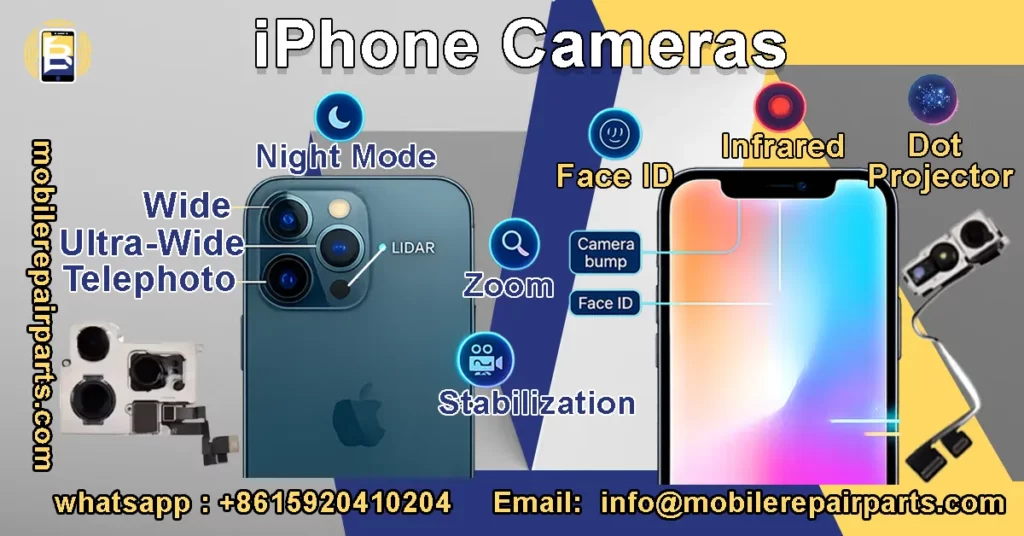
iPhone cameras are an integrated imaging system consisting of rear cameras and a front-facing camera, featuring image sensors, stabilization systems, autofocus, and image signal processors (ISPs) that all work seamlessly with iOS and the processor.
Rear Cameras on the iPhone
The rear cameras on iPhones from ( the iPhone 11, 12, iPhone 12 Pro Max, iPhone 13 Pro, iPhone 15 Plus, iPhone 16, iPhone 16 Plus, iPhone 16e, iPhone 16 Pro Max to iPhone 17 Pro Max) include multiple lenses (Wide / Ultra-Wide / Telephoto) and support technologies such as OIS, Sensor-Shift, Night Mode, and Deep Fusion. Pro models also feature a LiDAR sensor (a laser sensor that measures the distance between the camera and objects to improve focus, background isolation, and night photography).
Any malfunction in this unit may cause issues such as image shake, blurriness, or loss of focus.
The Front Camera on the iPhone
The front camera on iPhones is part of the Face ID system and includes sensors such as an infrared camera and a dot projector.
Any damage or unprofessional replacement may completely disable Face ID, making it one of the most critical components to handle during repairs.
Components of the iPhone Camera Module
Each camera contains:
Image Sensor.
OIS (Optical Image Stabilization).
Autofocus Motor.
Camera IC (Image Signal Processor).
Flex Cable.
Any malfunction in one of these components directly affects the camera’s performance.
What compatibility issues can arise after replacing iPhone cameras?
Installing an incompatible camera may result in the loss of Face ID on the front camera, shaking and blurring on the rear camera, a black screen and the camera not working, as well as warning messages on some newer models because the front and rear cameras contain calibration data linked to the motherboard.
What are the differences between iPhone cameras?
The main differences lie in the number of lenses, image resolution, sensor size, optical zoom capabilities, and exclusive software features for the iPhone Pro and iPhone Pro Max models.
1. Camera and Sensor System:
- Standard models: Feature a dual-camera system (main and ultra-wide).
- Pro models: Feature a third lens (telephoto) for zoom, in addition to a LiDAR sensor. This sensor not only improves low-light focusing but also maps the room in 3D, making Portrait mode in low light exceptionally professional.
2. Image Resolution and Sensor Size:
- Resolution: Starting with the iPhone 14 Pro, the Pro series has moved to a 48MP main sensor, while the standard models have lagged behind in this regard.
- Sensor size: The sensor in the Pro series is physically larger, which means greater light-gathering capability and reduced digital noise in photos.
3. Zoom capabilities:
- Standard models: Rely on digital zoom (cropping the image), which reduces quality, or 2x zoom achieved by cropping the main sensor.
- Pro / Pro Max models: Offer true optical zoom of up to 5x in newer models (such as the 15 Pro Max and , iPhone 16 Pro), which delivers extremely sharp images of distant subjects.
4. Professional Formats:
There are exclusive software features on the iPhone Pro series due to their processing power:
- Apple ProRAW: for shooting raw images that allow for professional color grading.
- Apple ProRes: for shooting high-quality cinematic video.
- Macro Photography: Capturing very close-up subjects (down to 2 cm) is exclusive to the Pro series thanks to the autofocus feature in the ultra-wide-angle lens.
5. Replacement and Compatibility (Software Encryption):
- Hardware Pairing: Each camera is linked via a serial number to the logic board.
- Technical Impossibility: A Pro camera cannot be installed on a standard device, not only because of differences in “programming” and encryption, but also because of the internal connectors (Flex Cables) and the motherboard design.
5. iPhone LiDAR Infrared Scanner

The LiDAR Infrared Scanner is a depth-sensing module that works by emitting infrared light pulses using VCSEL technology and then measuring the time it takes for them to reflect back, thereby creating an accurate 3D map of the surrounding environment. This sensor was first introduced in the iPhone 12 Pro and iPhone 12 Pro Max, and has continued to be available in all subsequent Pro and Pro Max models, such as the iPhone 15 Pro, iPhone 15 Pro Max, iPhone 16 Pro and iPhone 16 Pro Max.
This system is directly integrated with the image signal processor (ISP), the camera system, and augmented reality (AR) features, in addition to improving low-light autofocus. Therefore, it is a sensor component linked to the software and the iOS system, not just a standalone mechanical part.
In the wholesale market, this part is considered a low-volume item compared to screens or batteries, but it commands a high profit margin due to its scarcity and the difficulty of professionally refurbishing it.
Replacement often requires the use of special calibration tools to ensure full compatibility with the iOS system and correct processing of depth data. Therefore, wholesalers in Latin America are advised to focus on importing high-quality, compatible LiDAR units and testing them prior to distribution to avoid messages such as “Unknown Component” or loss of depth measurement accuracy in imaging and augmented reality (AR) applications.
Choosing reliable suppliers also reduces return rates and minimizes software compatibility issues within service centers.
6. iPhone Battery Back Cover
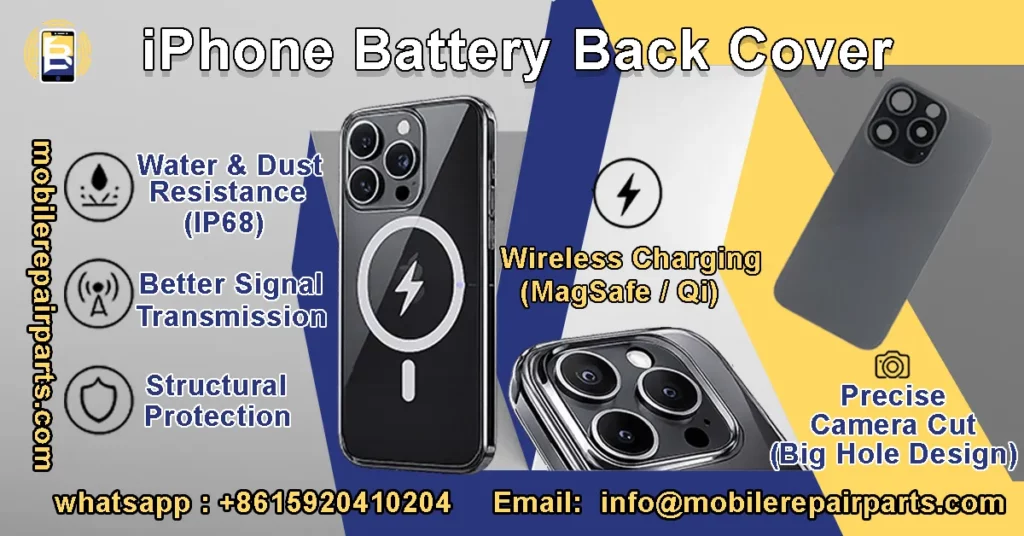
The iPhone battery cover, also known as the rear glass or rear housing, is a structural and aesthetic component that serves both protective and functional roles in modern iPhones. Starting with the iPhone 8 series and continuing through newer generations such as the iPhone SE 2020, iPhone 12, iPhone 13, iPhone 14, iPhone 15 Pro Max, iPhone 16 and iPhone 17 Pro series, Apple has transitioned to a glass back design to support wireless charging (MagSafe/Qi), improve signal transparency, and enhance water and dust resistance (IP68 rating).
The iPhone’s back cover has evolved from a purely aesthetic component to an essential structural part that ensures the phone’s safety. In newer models such as the iPhone 16 Pro Max and iPhone 17 Pro Max series, Apple uses tempered glass and titanium frames, making this component a product in constant demand in the wholesale market. However, true profitability depends on manufacturing precision that ensures a perfect fit and preserves the iPhone’s original durability and resistance.
For wholesalers importing from China, key technical criteria include laser-cutting precision to ensure perfect alignment of camera and microphone openings, full compatibility with wireless charging and MagSafe, and the correct glass thickness to avoid reducing energy transfer efficiency or magnetic strength. For high-end models such as the iPhone 15 Pro Max, iPhone 16 Pro, and iPhone 17 Pro Max, buyers also prefer “Big Hole” versions that simplify installation without removing the camera module, while maintaining the original color match and matte glass finish.
7. iPhone Middle Frame
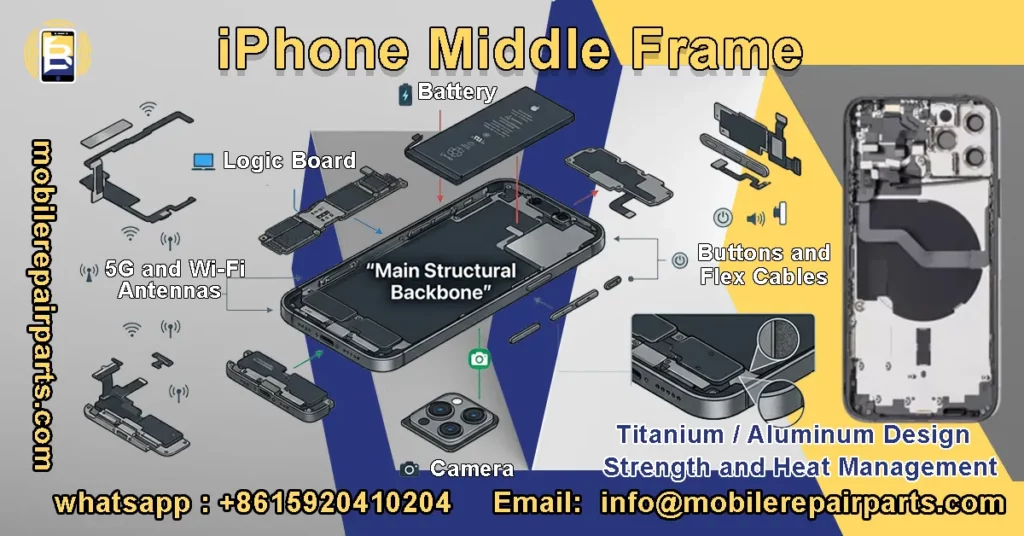
The iPhone Middle Frame, also known as the chassis or housing, is the central structural backbone that holds every internal component in place, from the logic board to the battery. The iPhone Middle Frame is much more than just a metal border; it is a precision-engineered part that includes integrated flex cables, buttons, and antenna bands essential for 5G and Wi-Fi reception. In the latest models like the iPhone 15 Pro and iPhone 16 Pro Max, the iPhone Middle Frame has transitioned to high-grade titanium and aluminum alloys, requiring exact thermal conductivity and structural integrity to support the device’s internal cooling and MagSafe alignment.
8. iPhone Vibration Motor (Taptic Engine)

The vibration motor iPhone is a small but critically important component, as it handles haptic notifications, call alerts, and tactile feedback. Its proper functioning directly impacts the user experience, so it is essential to choose high-quality replacement parts.
In the latest models, such as the iPhone 17, the Taptic Engine continues to evolve to deliver smarter and smoother haptic responses, as the phone relies entirely on these precise vibrations to compensate for the absence of traditional mechanical buttons. Therefore, installing a low-quality replacement motor will immediately cause mechanical noise (buzzing) and poor haptic feedback, which will ruin the iPhone’s premium feel.
9. iPhone Wireless Charging Coil
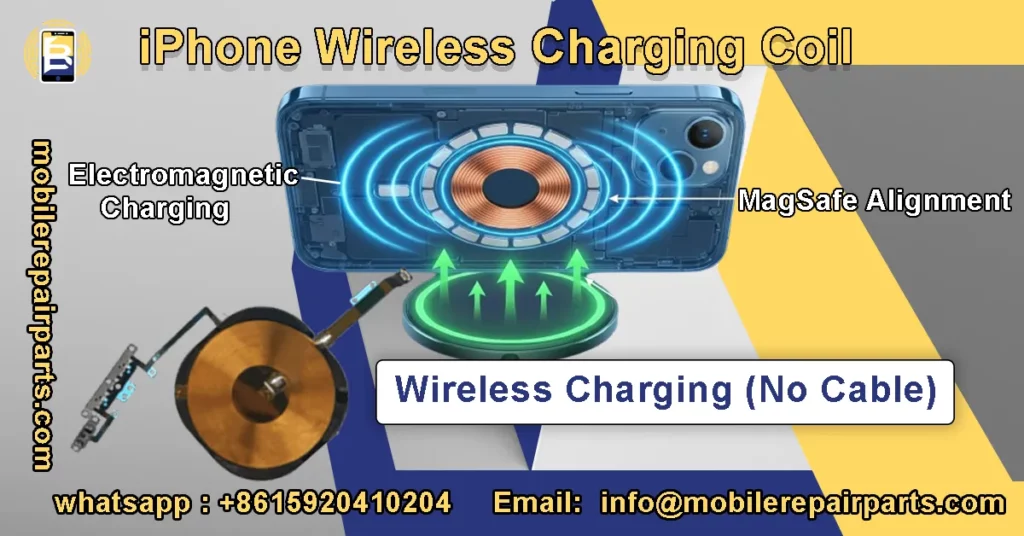
The iPhone Wireless Charging Coil is an internal component that enables wireless charging through electromagnetic induction, allowing the cell phone to charge without a cable. It is integrated into the rear of the phone and, in MagSafe-supported models (from iPhone 12 up to iPhone 17 Pro Max), works with a magnetic alignment system to ensure stable and efficient charging. This makes it a key element within the iPhone Spare Parts ecosystem.
10. iPhone Microphones

The iPhone microphone is an internal MEMS component responsible for capturing audio signals during calls, voice recordings, Siri commands, and video recording. Modern iPhones use multiple microphones (bottom, front, and rear) integrated with noise-cancellation algorithms, making this part a critical element within the iPhone Spare Parts ecosystem.
How many microphones does an iPhone have, and what do they do?
An iPhone typically has 3 to 4 microphones strategically placed throughout the iPhone, the bottom microphone (next to the charging port), which is primarily responsible for picking up your voice during regular calls, the front microphone (built into the earpiece), which is used for FaceTime calls, Siri, and ambient noise cancellation; and the rear microphone (next to the camera lenses), which records audio while shooting video and supports “Audio Zoom.” In newer models such as the iPhone 15 Pro and even the iPhone 17, this system works together to produce Spatial Audio and advanced noise cancellation using artificial intelligence, resulting in professional-grade recording quality that rivals external equipment.
What are the most common iPhone microphone issues that technicians encounter?
Weak or muffled sound, static or crackling, or no sound at all.
The cause is usually dust, liquid damage, or damage to the flex cable, not the microphone itself.
For more information about the microphone and how to replace it professionally, please refer to this comprehensive guide: How can you replace an iPhone microphone?.
11. iPhone Ear Speaker (Earpiece Speaker)
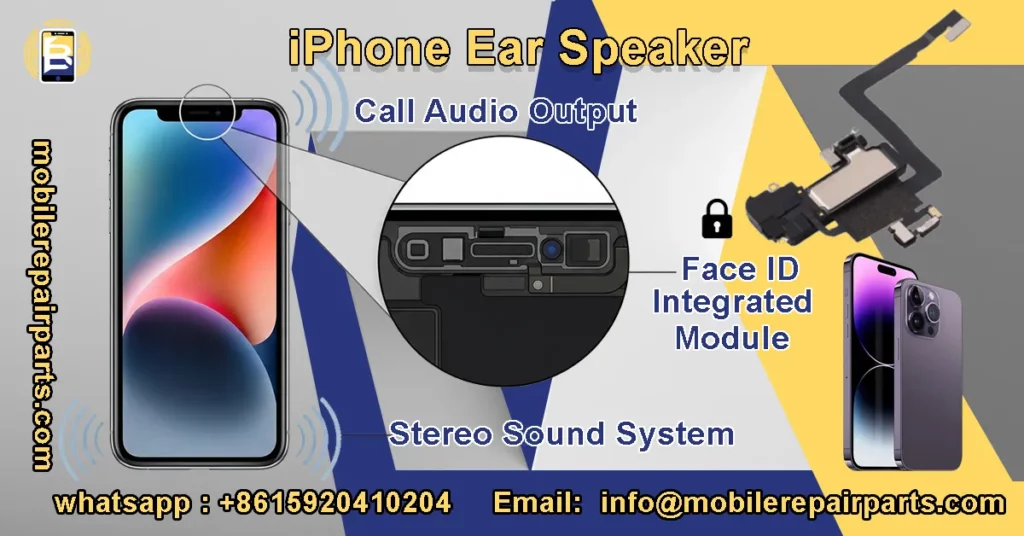
The iPhone ear speaker is the front top speaker responsible for call audio output, allowing users to hear the other party during phone calls. It is usually integrated with the front sensor flex (Face ID assembly), making it a sensitive component within the iPhone Spare Parts ecosystem.
This speaker works in combination with noise cancellation and audio IC systems to deliver clear voice frequencies (mid-high range). In newer models iPhone 13 up to iPhone 17, it also contributes to stereo sound alongside the bottom speaker. Because it is linked to the front flex, improper replacement may affect Face ID functionality, making installation precision critical for technicians.
Common Problems with the iPhone Ear Speaker:
| Fault | Common Cause | Professional Solution (for technicians and wholesalers) |
|---|---|---|
| Low or muffled sound during calls | Dust and grease buildup inside the ear speaker mesh or blockage of fine acoustic openings | Professional cleaning using fine brush + isopropyl alcohol + sound pressure testing before replacement |
| No sound from ear speaker at all | Failure of the ear speaker module or interruption in the flex cable | Replace the complete upper ear speaker unit and perform compatibility testing before installation |
| Crackling or distorted sound | Moisture or water ingress causing internal corrosion of the speaker coil | Professional internal drying + contact point cleaning; if issue persists, replace the full unit |
| Weak sound after iPhone drop | Partial flex disconnection or mechanical damage in the upper assembly | Inspect flex cable connected to proximity sensors, then replace ear speaker unit with top frame if needed |
| Ear speaker not working after screen replacement | Improper installation or misalignment of the speaker with the sound channel in the display | Precise reassembly, correct sensor alignment, and ensure no pressure on Face ID area |
| Sound only works on loudspeaker | Failure in ear speaker audio path or incorrect audio routing | Check audio settings and perform hardware diagnostics; if hardware-related, replace ear speaker module |
12. iPhone Loud speaker

The iPhone loud speaker is the main audio output component responsible for playing music, videos, ringtones, and speakerphone calls. It works together with the earpiece speaker to provide stereo sound in modern iPhones.
In newer models such as iPhone 13 to iPhone 17 series, Apple has improved sound clarity, volume, and bass response through better speaker design and software tuning.
Where is the loud speaker located on an iPhone?
The loud speaker on an iPhone is located at the bottom of the phone, near the charging port.
Common iPhone Loud Speaker Issues
Distorted or crackling sound, low volume, no sound at all, and intermittent sound.
- Distorted or crackling sound: usually caused by internal diaphragm damage or dust blocking the speaker mesh.
- Low volume: often due to clogged mesh or reduced magnetic performance inside the speaker unit.
- No sound at all: may result from a faulty flex cable or internal electrical failure.
- Intermittent sound: commonly linked to poor contact points or issues in the charging flex connection.
13. iPhone Charging Port
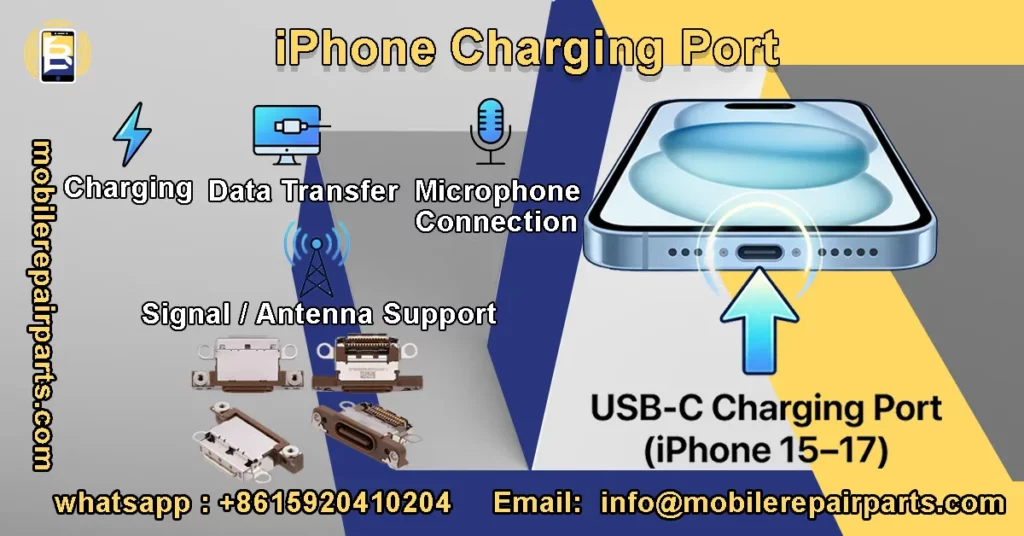
The iPhone Charging Port is a key component responsible for charging, data transfer, and in some models connecting the bottom microphone and antenna functions. In modern iPhones,from iPhone 15 to iPhone 17 series, Apple uses USB-C ports that support faster charging and higher data speeds compared to Lightning.
What are the common problems with the iPhone charging port?
Common iPhone charging port issues: charging failure or intermittent charging, weak or unstable connection, computer failing to recognize the phone (data transfer failure), slow charging, call microphone malfunctions, and weak or lost network or Wi-Fi signal.
14. iPhone SIM Card Tray

The iPhone SIM Card Tray is a small removable component used to hold and secure the SIM card inside the phone, ensuring stable network connectivity. It is typically made of aluminum or stainless steel for durability and precise fitting, and varies in design depending on the iPhone model and regional version (single SIM or dual SIM in some markets).
Although it is a low-cost iPhone spare part, it plays an essential role in maintaining proper cellular communication. Damage or misalignment of the SIM tray can lead to issues such as SIM card not being detected, network instability, or difficulty inserting/ejecting the SIM.
Why is the iPhone SIM Card Tray important for wholesalers and repair technicians?
The SIM tray must match the phone’s color (Color Matching) and have precise dimensions to ensure the SIM card stays secure and avoid the “No SIM” error, especially in models like the iPhone 16, and iPhone 17 series. It is also preferable that it be made of durable metal resistant to breaking or bending, as it is one of the most frequently replaced parts due to loss or damage. With the spread of eSIM in some modern iPhone models, demand may decrease in certain markets, while it remains very important in other global markets, requiring wholesalers to consider model variations by region when importing.
15. iPhone SIM Connector
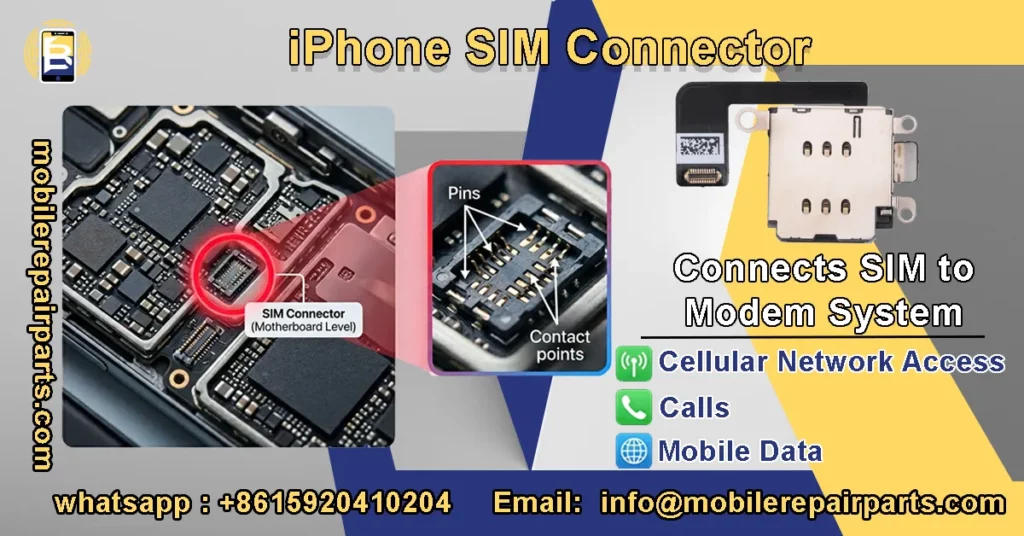
The iPhone SIM Connector is the internal contact interface on the logic board that reads and communicates with the SIM card inserted through the SIM tray. It acts as the electrical bridge between the SIM card and the iOS modem system, enabling cellular network access, calls, and mobile data functionality.
Unlike the SIM tray, which is a physical holder, the SIM connector is a highly sensitive motherboard-level component. Any damage, bending of pins, or corrosion (often caused by moisture or improper SIM insertion) can lead to serious network failures.
Common Issues with the iPhone SIM Connector
Messages such as “No SIM” or “Invalid SIM” may appear even though the SIM card is intact, due to damaged pins or poor contact points. You may also experience weak or unstable network signals or frequent service interruptions, especially after the device has been dropped or repaired. Other common causes include bent or broken pins due to an ill-fitting SIM tray, or corrosion (oxidation) of the connectors caused by moisture near the charging port, leading to complete or partial loss of network connection.
16. iPhone Rear Camera Lens Cover

The iPhone Rear Camera Lens Cover is the external protective glass that sits directly over the rear camera modules. Its main role is to protect the camera sensors from scratches, dust, and impact while maintaining full optical clarity for photography. Any damage to this cover directly affects photo quality.
Modern iPhones use strengthened glass (often sapphire-coated on Pro models such as iPhone 16 Pro), but it remains vulnerable to impact due to its exposed position on the phone’s rear housing.
Why are iPhone camera lens covers important for wholesalers and repair technicians?
Because they are parts that are frequently broken due to drops, resulting in constant demand at repair centers. They are also low-cost but high-turnover items in the market, and they vary by iPhone model, requiring precision in compatibility during import or installation. They are often replaced along with the rear glass or during camera repairs to ensure the original image quality is restored.
17. iPhone Power Button Outer
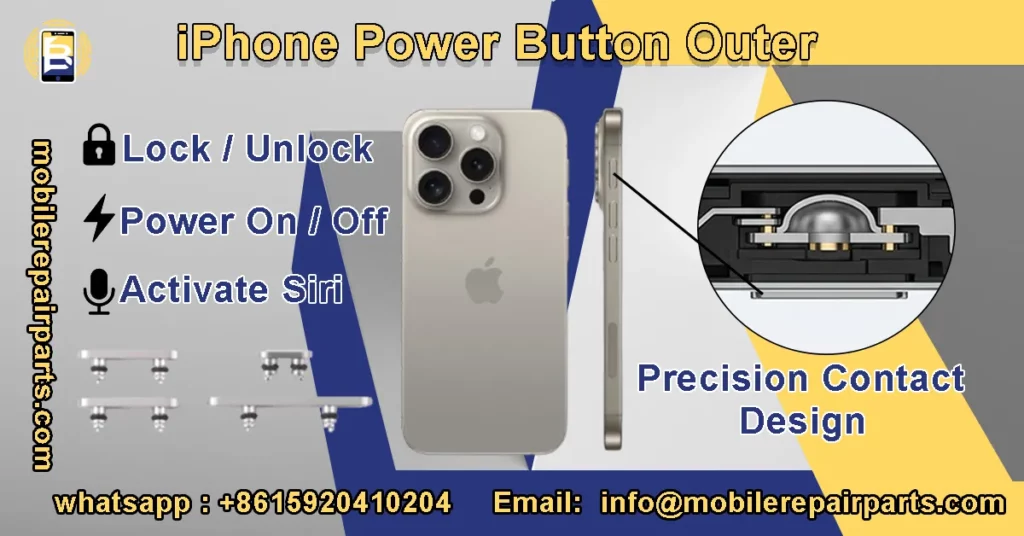
The power button on the iPhone is an essential component for turning the phone on and off, locking it, and activating features such as Siri. In models like the iPhone 15 Pro Max and iPhone 16, this button has been redesigned to offer a slimmer and more durable design, with precise contact points that ensure full compatibility with iOS.
For more detailed insights about button-related repairs, especially the Home Button, check our comprehensive guide: iPhone 7 Home Button Repair.
18. iPhone volume side button
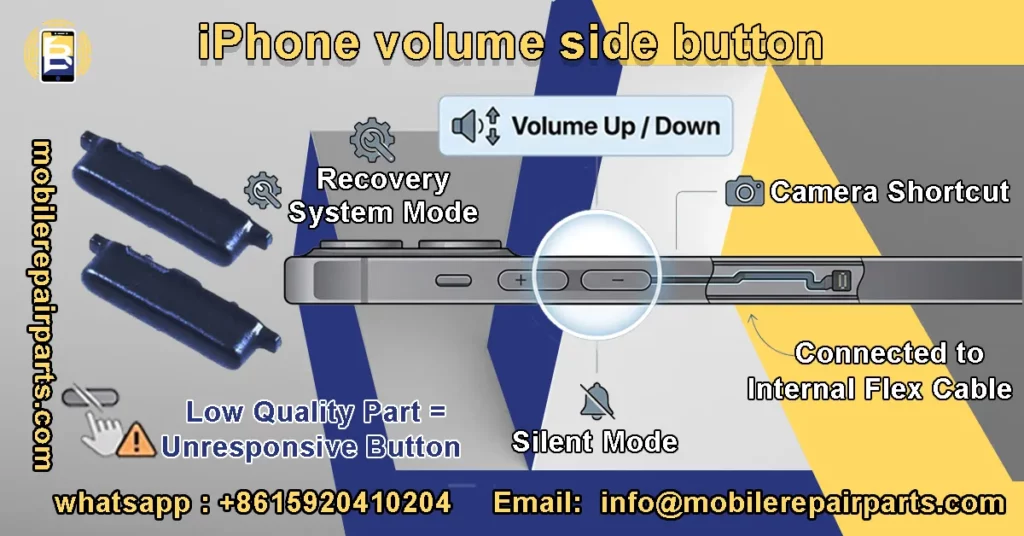
The side volume button on the iPhone controls volume levels, ringtones, and media audio. This button plays a central role in system shortcuts, such as taking photos, enabling silent mode, and entering Recovery Mode when performing software maintenance. In models such as the iPhone 16 and iPhone 17 series, this button is part of a sophisticated side-button system connected to an internal flexible cable, making it more than just a simple mechanical button.
Any damage or bending of the frame, or replacement with a low-quality part, can cause the volume control button to become unresponsive. For wholesalers and technicians, it is important to choose durable, model-specific buttons with precise dimensions and reliable tactile feedback to ensure proper installation and avoid returns.
19. iPhone Camera Control Button
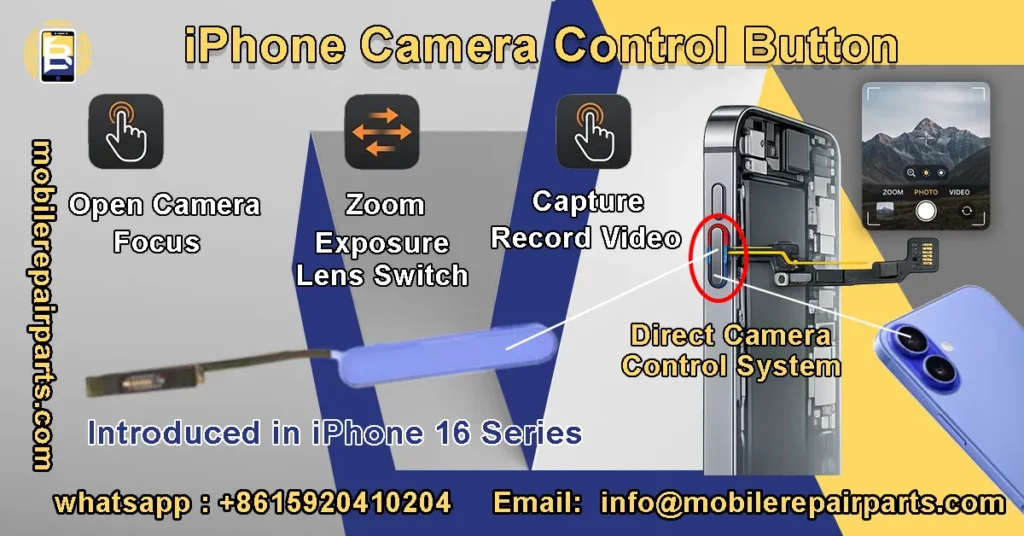
The iPhone camera control button is a dedicated physical button introduced in the latest generation of iPhones, starting with the iPhone 16 series. It is designed to provide quick access to camera functions such as taking photos, recording videos, zooming, and adjusting focus. This button is part of Apple’s push toward more intuitive, hardware-based camera interaction.
What are the technical features and functions of the iPhone Camera Control Button?
The iPhone Camera Control Button combines a light press to open the controls or adjust focus, a swipe to change settings such as zoom, exposure, and lenses, and a deep press to take photos or start recording video.
20. iPhone Power Button Flex Cable
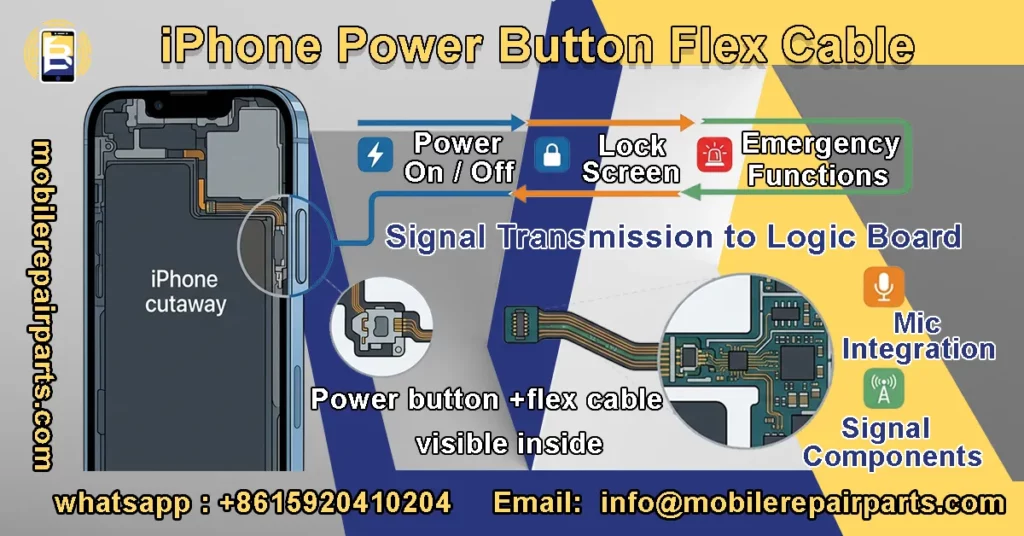
This cable transmits the pressure signal from the button to the logic board. It is a complex component that often integrates additional sensors, such as noise-canceling microphones or signal-boosting antennas, making it one of the most sensitive parts of the iPhone’s structure. It enables essential functions such as powering on/ powering off the iPhone, locking the screen, and activating emergency or accessibility features.
21. iPhone Signal Cable
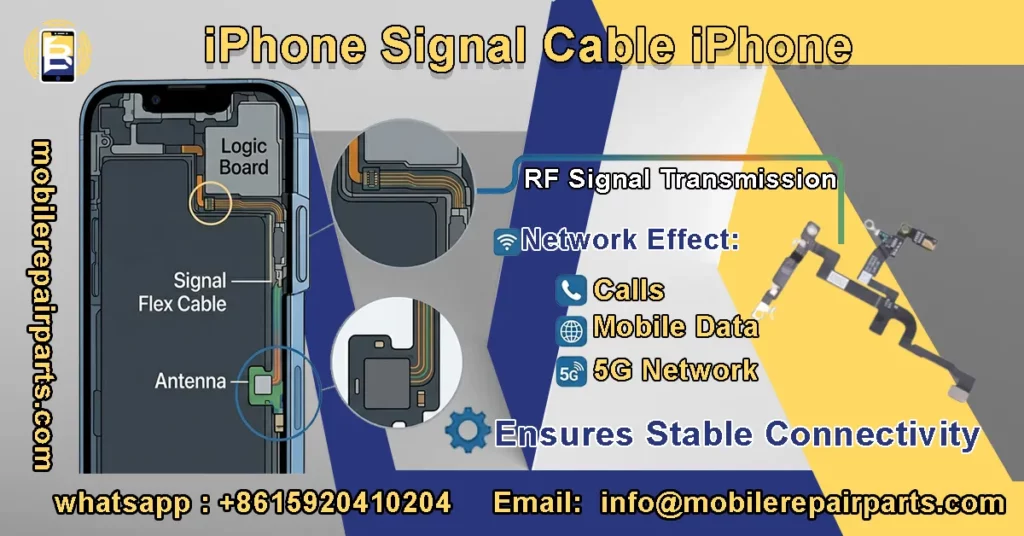
The iPhone signal cable is an internal flexible cable responsible for transmitting RF (radio frequency) signals between the logic board and the antenna modules, enabling stable cellular connectivity (calls, mobile data, and network reception). It plays a critical role in maintaining signal strength and overall communication performance, especially in modern iPhones(like iPhone 16e and iPhone 16 Pro) that support advanced networks such as 5G.
22. Volume Button Flex Cable
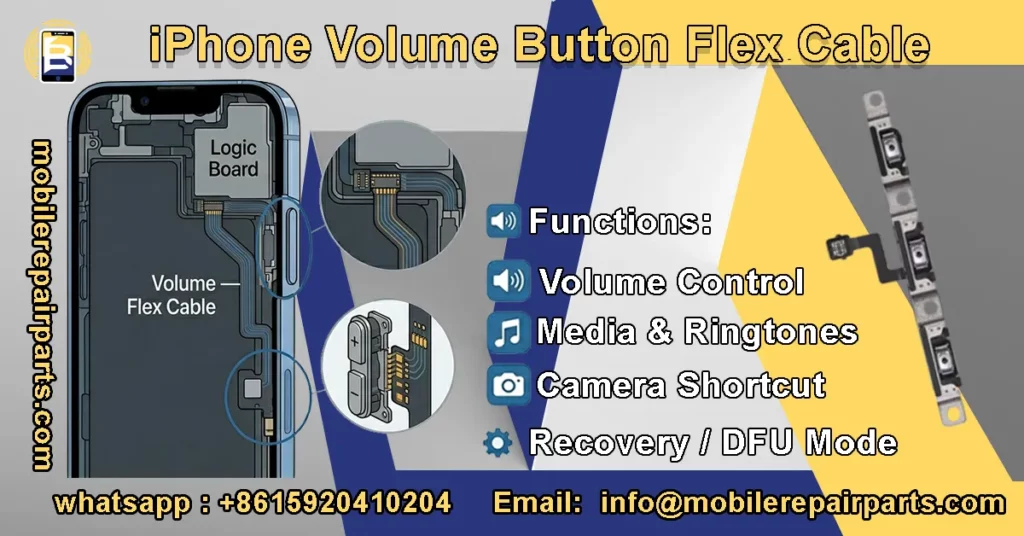
The iPhone volume button flex cable is the internal component that connects the external volume buttons to the logic board, enabling precise control of sound levels, ringtones, and media playback. It also supports key system functions such as taking photos, activating shortcuts, and entering recovery or DFU modes during maintenance.
23. iPhone Antenna
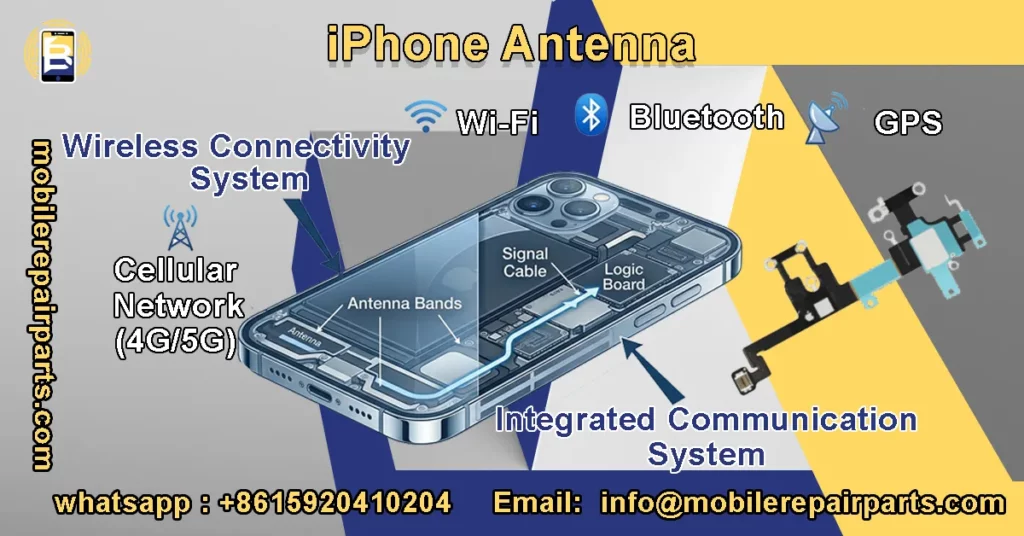
The iPhone antenna is a key component responsible for wireless connectivity, including cellular networks, Wi-Fi, Bluetooth, and GPS. It works with the signal cable and logic board to ensure stable signal performance.
In modern iPhones, the antenna is integrated into the frame and internal modules, making it more efficient but also more sensitive to damage. Any issue can cause weak signal, dropped calls, or “No Service”.
For a broader understanding of the common issues faced by iPhone users and their concerns that go beyond the phone’s hardware, you can check out: Top 10 Common iPhone Questions.
Tools Technicians Need to Ensure Proper Installation of iPhone Spare Parts
Professional handling of iPhone spare parts requires a set of precision maintenance tools that minimize the risk of damaging delicate components, most notably: specialized screwdrivers, non-magnetic tweezers for precise handling, and plastic prying tools to avoid cutting cables. It is also recommended to use an anti-static mat (ESD) and a screen stabilizer to ensure safe and stable work during installation.
How to Choose Reliable iPhone Spare Parts Suppliers and Avoid the Risks of Buying in Bulk?
To choose a reliable supplier of iPhone spare parts, test samples before purchasing, ensure that the quality rating is clear, and verify that a warranty and return policy are in place. Additionally, work with reputable suppliers to minimize the risks of buying in bulk.
For high-quality, tested, and reliable iPhone spare parts with direct shipping from China and competitive wholesale prices, contact BETA Electronic Co Ltd for a customized quote and professional technical support.
Staying informed about battery technologies, compatibility, and wholesale trends is also essential when importing iPhone spare parts from China, so it’s important to explore specialized articles on batteries to gain deeper technical and market insights:
- iPhone 11 Battery Bulk.
- iPhone 14 Plus Battery Ultimate Guide.
- iPhone 15 Plus Battery Bulk.
- iOS 18 Battery Compatibility.
How can I minimize financial risks when buying iPhone spare parts in bulk?
By starting with small trial orders and using secure payment methods.
FAQ About iPhone Spare Parts
Why is the battery IC important in iOS systems?
Because the quality of the IC chip ensures that Battery Health is displayed correctly and prevents warning messages such as “Unknown Part” from appearing.
Why does “Portrait Mode” fail in low light, even though the camera works normally on iPhone Pro models?
Because the camera relies entirely on the LiDAR sensor for depth mapping and background isolation in the dark. If you can take regular photos but background isolation fails or appears “blurry” in low light, this means the LiDAR sensor is malfunctioning, not the camera module itself.
Can a malfunction in the Taptic Engine affect other functions on the phone?
A malfunction in the iPhone’s vibration motor may cause a sensation of “stuttering” while interacting with the phone. On some phones, a complete loss of vibration may result in a slight delay in app performance during tasks that rely heavily on touch, though this will not prevent the phone from functioning.
Can the microphone on an iPhone be replaced on its own?
No, because it is integrated into a flex cable (such as the charging flex or front flex), so the entire assembly must be replaced.
Why is compatibility important in iPhone spare parts?
Because modern iPhones require software pairing and serialized components to function correctly.
What is the best replacement screen for iPhone?
Soft OLED is the closest to original quality with best performance and lowest return rate.
Why does the “Unknown Part” warning appear after a battery replacement?
It occurs because the new battery’s serial number is not digitally paired with the iPhone’s logic board.
What is the best way to store delicate iPhone spare parts, such as screens?
In a dust- and moisture-free environment, using anti-static packaging to prevent damage to the IC or screen.
Why does the “Part Not Genuine” message appear when installing genuine iPhone spare parts that have been removed from another phone?
This message appears because iPhone spare parts (even genuine ones) are programmatically linked to the original motherboard via encrypted serial numbers; replacing the part without transferring the IC chip breaks this link.
How can you verify the quality of the IC in iPhone spare parts before beginning the soldering process on the motherboard?
The IC is tested using specialized programming devices to read its calibration data and ensure that it is genuine and not a poorly remanufactured part.
Does updating iOS affect the compatibility of non-Apple-certified iPhone spare parts?
Yes, iOS updates may impose new software restrictions that detect a mismatch in the “digital signature” of non-genuine iPhone spare parts, which may disable features such as True Tone.
What are the best ways to clean iPhone charging ports before deciding to replace them?
Use a very soft toothbrush with isopropyl alcohol (99%), and avoid sharp metal tools entirely.
Does using a non-compliant bezel affect the IP68 water resistance rating?
Yes, any non-precise bezel leaves microscopic gaps that prevent the screen from sealing tightly, completely negating the device’s ability to resist water and liquids.
Success in the iPhone spare parts and repair business means having a clear understanding of each component and how it affects iPhone performance and the user experience, as well as working with a reliable supplier that provides genuine, tested parts and compatible with True Tone and Face ID features. Contact BETA Electronic Co Ltd for a wholesale price list and fast direct shipping solutions from China to Latin American markets.