


To ensure customer satisfaction and reduce returns, wholesalers need to know the difference between genuine and counterfeit iPhone screens, as well as between screen types: OLED, In-Cell, and TFT. Each type differs in color accuracy, brightness, and touch response, and understanding these differences helps you make smarter purchasing decisions and ensures consistent performance and service quality.
This guide provides technical specifications and inspection protocols to distinguish between genuine iPhone OLED, In-Cell, and TFT screens.
|
📘 Summary Mastering the differentiation between original and copy iPhone screens is crucial for distributors, repair technicians, and wholesale suppliers in Latin America. This guide provides practical insights into identifying high-quality OLED, AMOLED, and TFT screens, focusing on color accuracy, brightness, touch responsiveness, True Tone functionality, and build quality, while offering actionable tips to avoid low-grade copies and ensure customer satisfaction. |
🔍 Key Highlights
|
Table of Contents
What are OLED screens for iPhones, and why are they considered high-quality screens?

OLED (Organic Light Emitting Diode) technology represents a paradigm shift in Apple’s display engineering, integrated into all flagship models starting with the iPhone X. Unlike legacy Liquid Crystal Displays (LCDs), OLED iPhone screens utilize self-emissive pixels, eliminating the requirement for a dedicated backlight unit (BLU).
Technical Advantages:
- Infinite Contrast Ratio: Achieves true black levels by completely de-energizing individual pixels (True Black).
- Energy Efficiency: Optimizes power consumption, particularly in “Dark Mode,” as only active pixels draw current.
- Structural Form Factor: The absence of a backlight allows for a significantly thinner display module and a flexible substrate that enables reduced bezel thickness.
- Chromatic Accuracy: Delivers superior color fidelity and seamless integration with Apple’s proprietary True Tone algorithms and Face ID biometric calibration.
Aftermarket Classification
In the secondary parts market, OLED iPhone screens are categorized based on manufacturing origin and substrate flexibility:
| Category | Technical Specification |
|---|---|
| Original OEM | Authentic panels sourced directly from authorized supply chains (e.g., Samsung Display or LG Display). |
| Refurbished | Original OLED matrices that have undergone professional glass replacement while retaining the genuine IC and digitizer. |
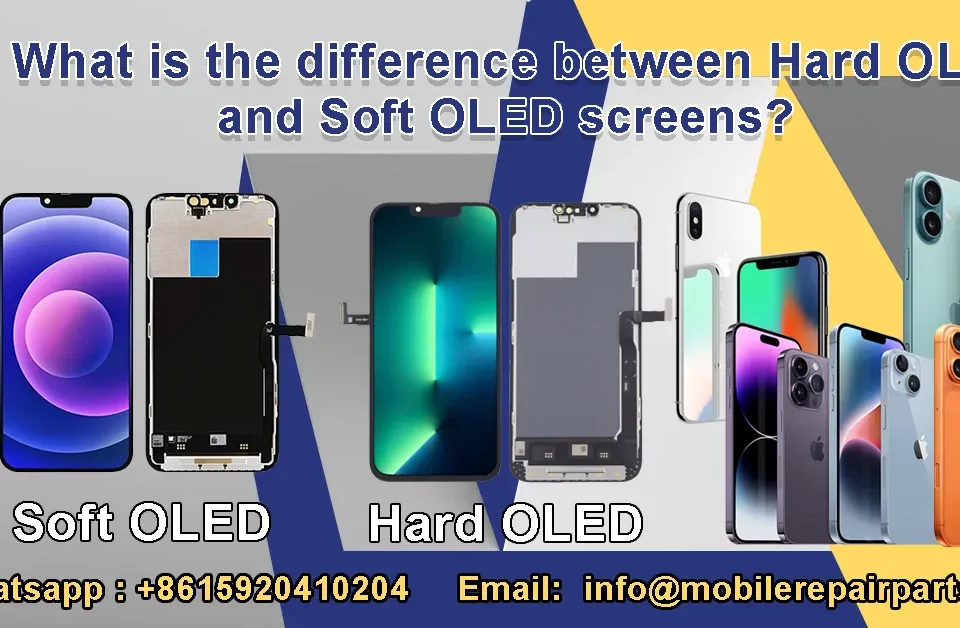
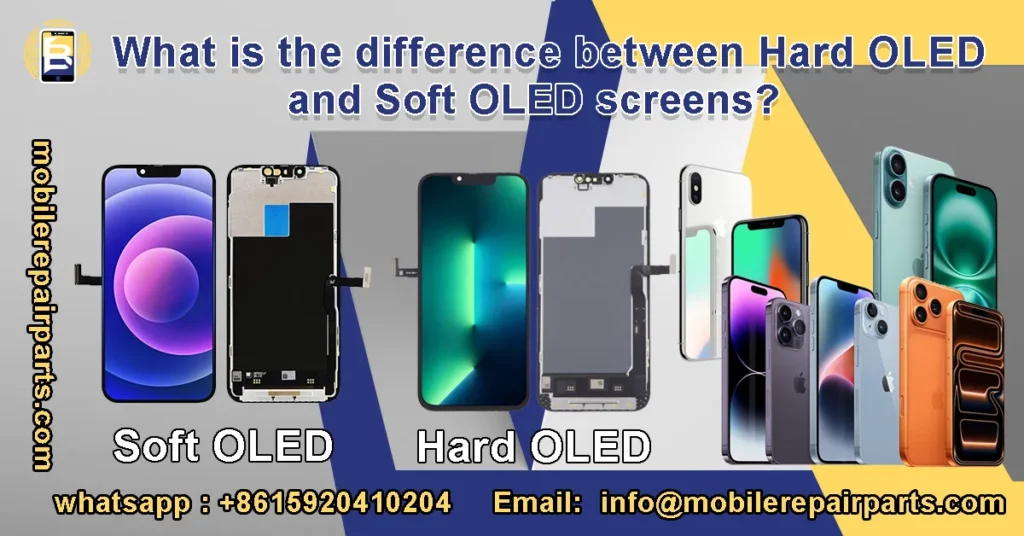
| Soft OLED | High-grade aftermarket panels built on a flexible polymer substrate, mimicking the impact resistance and bezel dimensions of the original. |
| Hard OLED | Cost-effective alternatives utilizing a rigid glass substrate; more susceptible to impact damage and usually feature slightly larger chin bezels. |
What Are In-Cell iPhone Screens and Why Are They Popular in the Aftermarket?

In-Cell iPhone screens utilize an advanced engineering technology that integrates the touch sensor layer directly into the liquid crystal matrix (LCD Panel), rather than functioning as a discrete layer on top of the display. This structural integration reduces the overall thickness of the module and significantly lowers manufacturing costs, making it the dominant choice in the mobile phone parts market, particularly in Latin America.
Technical Advantages:
- Cost-Efficiency: Offers an optimal performance-to-price ratio compared to OLED technology.
- Luminance & Brightness: Delivers high-intensity brightness levels, ensuring functional visibility under various ambient lighting conditions.
- Structural Profile: The fusion of the touch layer allows for a chassis that is thinner than traditional Out-Cell or COG (Chip-on-Glass) LCDs.
- Supply Chain Stability: Available in large quantities in the Chinese wholesale market at competitive prices, ensuring continuity of supply to maintenance centers.
Operational Performance (vs. OLED)
- While highly efficient for budget-conscious repairs, In-Cell displays differ from OLED iPhone screens in several key metrics:
- Contrast Ratio: Lower dynamic range due to the constant activity of the LED backlight.
- Bezel Dimensions: Slightly wider borders (bezels) to accommodate the backlight diffusion layers.
- Power Management: Higher power draw as the backlight must remain fully illuminated to display content.
- Color Accuracy: Standardized color gamut which, while stable, lacks the high-saturation vibrance of organic emitters.
Despite these differences, for many repair businesses, In-Cell remains the primary iPhone screens replacement type imported from China due to its proven durability and affordable price point.
For additional guidance on replacing screens in Latin America, see the following articles:
What Are TFT iPhone Screens and When Should Repair Shops Use Them?

TFT (Thin Film Transistor LCD) iPhone screens are the most economical option on the spare parts market. These screens use Active Matrix technology, where each pixel is controlled by a separate transistor, but they remain the entry-level option compared to OLED or In-Cell LCD technologies.
Technical Specifications:
TFT screens have the following characteristics that should be considered during inspection and installation:
- Build: They come in thicker models due to the separate backlight unit, which may require greater precision when closing to ensure there are no gaps in the frame.
- Power consumption: They consume higher power draw because the backlight is fully and continuously lit, unlike OLED iPhone screens that turn off black pixels.
- Display efficiency: They offer limited brightness levels (Nits) and viewing angles, with less accurate color contrast compared to the original standards.
- Touch Layer: Often uses a separate touch layer, making it a practical choice for basic everyday use but with sensitivity that differs from original screens.
When do experts recommend using TFT screens?
Professional wholesalers and iPhone technicians utilize TFT (Thin Film Transistor) LCDs in these four specific scenarios:
- Economical repair services: For customers looking for the lowest possible cost to get their mobile phone working again.
- Resale devices: Ideal for refurbishing used cell phones for the budget market.
- Refurbishment projects: Frequently used in large-scale refurbishment operations to reduce inventory costs.
- Data recovery: An ideal option as a “test screen” for technicians to extract data from damaged phones at a low cost.
What Are the Key Differences Between OLED, In-Cell, and TFT iPhone Screens?
Understanding the subtle technical differences between these types of iPhone screens helps wholesalers and technicians choose the most suitable displays for their target market, reduce risk when purchasing in bulk, and understand the impact of display type on cost, quality, and the end-user experience.
Comparison Table of iPhone Screens:
| Feature / Specification | OLED iPhone Screens | In‑Cell LCD iPhone Screens | TFT LCD iPhone Screens |
|---|---|---|---|
| Technology Type | Organic self-emissive, no backlight required | LCD with integrated touch | LCD with simple transistor |
| Contrast | Excellent (true black) | Relatively good | Low compared to others |
| Black Levels | Very deep, pixels can turn off completely | Dark gray | Pale gray |
| Screen Thickness | Very thin | Relatively thin | Relatively thick |
| Power Consumption | Highly efficient, especially with dark content | Medium | Less efficient |
| Viewing Angles | Excellent | Good | Relatively limited |
| Color Accuracy / Vibrancy | Vibrant and highly saturated | Realistic colors | Lower color accuracy |
| Touch Response | Very fast and precise | Good | Good but not advanced |
| Backlight Requirement | Not required | Required | Required |
| Production Cost | High | Medium | Low |
| Burn‑in Risk | Potential in OLED with prolonged static content | None | None |
| Longevity / Usage Sensitivity | Long lifespan on average but burn-in possible | Reliable lifespan | Shorter lifespan |
| Manufacturing Complexity | High | Medium | Low |
iPhone Screen Market Trends in Latin America
Importers usually rely on a mix of screens:
- Soft OLED for premium, high-quality displays.
- In‑Cell LCD for the mid-range segment.
- TFT LCD for the budget segment.
This mix ensures:
- Meeting the diverse needs of repair shops and technicians.
- Competitive pricing for wholesale trade.
- Reducing the risk of unsellable inventory.
You may also be interested in:
- iPhone 17 Pro Max OLED Screen.
- iPhone 16 Pro Max Screen Wholesale.
- Maximize Profits with iPhone 16 Pro Screen.
How to Distinguish Original vs. Fake iPhone Screens?

In the iPhone screen import market from China, the technical gap between Original Pull or Refurbished displays and Aftermarket (In-Cell LCD/OLED Copy) versions lies in subtle, high-level details. Here are the evaluation standards relied upon by inspection experts:
1. Inspecting Flex Cables and Benchmark Markings
The physical composition of flex cables serves as a primary diagnostic for screen authenticity. Authentic Apple screens use high-grade polymer flex cables, whereas aftermarket copies use rigid, low-cost plastics that are prone to cracking.
2. True Tone Compatibility and IC Logic Programming
Testing “True Tone” alone is no longer sufficient, as modern programmers can transfer data. The difference appears in the stability of the response:
- Technical Aspect: Original screens contain an IC that supports precise calibration data storage. Technicians use devices like JCID V1SE or QianLi iCopy; fake screens may sometimes reject data or lose the True Tone feature after an iOS update.
- Wholesale Tip: Ensure the screens support Ambient Light Sensor data transfer to guarantee that the Auto-Brightness feature does not malfunction.
3. Matrix, Color, and Brightness Analysis
This is where the difference between true OLED and cheap In-Cell LCD screens becomes evident:
- Deep Blacks: In original OLED screens, black pixels are completely turned off (True Black). In fake versions (especially In-Cell LCD), black appears grayish due to the presence of a backlight.
- White Balance: Fake screens tend to have a bluish or pale yellowish tint.
- Power Consumption: Non-original In-Cell screens consume up to 20% more battery power than authentic OEM OLED panels due to the constant power requirement of the LED backlight.
4. Frame Structure and Oleophobic Coating
This test is the fastest for wholesalers when inspecting shipments:
- Water Drop Test: Original and premium screens feature a strong Oleophobic coating; when a water drop is placed, it should stay intact like a bead and move smoothly without leaving a liquid trail. On cheap screens, the drop spreads and breaks apart.
- Bezel Thickness: Fake screens (especially for iPhone 11 and above) feature slightly wider black borders than the originals, making the display area appear smaller within the phone’s metal frame.
Technical comparison: Original display specifications vs. aftermarket displays
| Technical Feature | Original Screen (Original/OEM) | Fake Screen (High Copy/In‑Cell) |
|---|---|---|
| Screen Type | OLED (in modern models) | Mostly In‑Cell LCD or low-quality OLED |
| Touch Accuracy | 1:1 with very fast response | May experience “Touch Ghosting” or lag |
| Light Transmittance | Very high (clear visibility under sun) | Low (difficulty seeing in strong light) |
| Internal Soldering | Hidden and protected by insulating layers | Sometimes visible and irregular |
| iOS Compatibility | Fully compatible with all updates | May trigger “Unknown Part” message |
Why do professional traders and technicians prefer high-quality iPhone screens?
Wholesalers and professional technicians prefer high-quality iPhone screens (Soft OLED and OEM Grade) to ensure long-term profitability and reduce technical failures. This preference is due to two key factors:
1. Operational Cost Reduction
Relying on high-quality components directly minimizes:
- Maintenance Returns (RMA): Reduces losses incurred from the repeated labor of removing and reinstalling replacement screens.
- Touch Issues: Prevents “ghost touching,” lagging, or unresponsive digitizers.
- Battery Drain: Offers superior power efficiency compared to low-grade aftermarket copies.
2. Enhancing Market Value
High-quality screens contribute to:
- Service Center Reputation: Building customer trust that ensures repeat business and loyalty.
- Resale Value: Preserving the cell phone’s value, maintaining an “as-original” (OEM-like) condition.
- Reliability: Ensuring the device continues to function without sudden failures after delivery.
FAQs about iPhone Screens
What is the best replacement for iPhone screens?
For professional repairs, Soft OLED iPhone screens offer the best balance between price and original display quality.
Are In-Cell iPhone Screens good for repairs?
Yes. In-Cell iPhone Screens are widely used for mid-range repairs, especially in Latin American markets where affordability is important.
Why are TFT iPhone Screens cheaper?
TFT iPhone screens use older LCD technology with lower manufacturing costs, making them the least expensive option for bulk repairs.
Do aftermarket iPhone screens support True Tone?
Yes, Some high-quality iPhone screens support True Tone restoration when programmed with tools like JCID or QianLi.
With the continuous expansion of the iPhone parts market in Latin America, understanding the differences between OLED, In-Cell, and TFT screens has become vital for wholesalers and professional technicians. Choosing the right screen maintains phone performance and battery efficiency, and also enhances the reputation of the repair center and ensures long-term customer satisfaction.
If you want to elevate your business and ensure the availability of reliable iPhone screens, leave no room for doubt or error. Visit mobilerepairparts today to explore a wide range of high-quality iPhone screens, experience the difference for yourself, and start earning higher profits with reliable and guaranteed products.