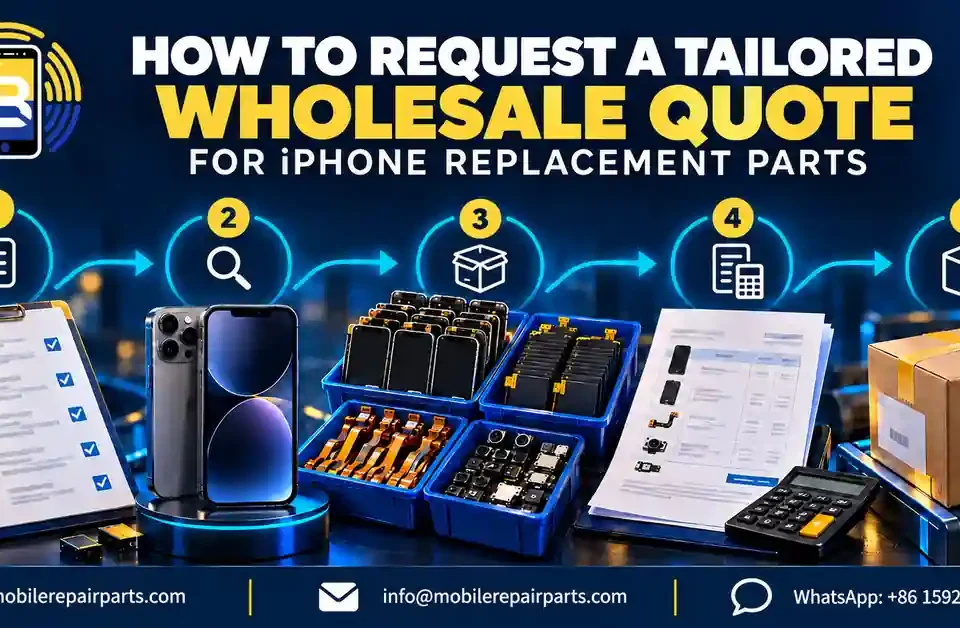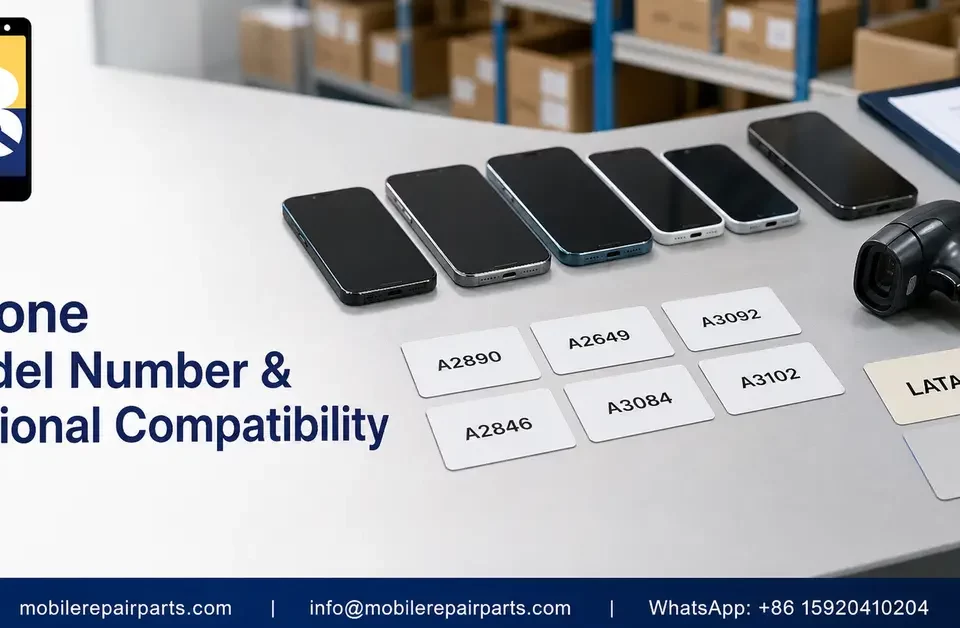



Replacing an iPhone part is not simply a matter of finding a component that looks similar. The correct replacement must match the exact iPhone model, regional variant, connector generation, internal layout, quality grade, and repair requirements. For wholesalers and technicians serving Honduras, Chile, Colombia, Ecuador, and the wider Latin American region, compatibility mistakes can create rejected orders, installation delays, warranty claims, and unnecessary inventory costs. This 2026 guide provides a practical iPhone parts compatibility matrix for wholesale buyers and technicians.
📘 Summary
For wholesale iPhone parts, compatibility depends on the exact model, regional variant, connector generation, internal layout, quality grade, and documented test status.
🔍 Key Highlights
- Confirm the exact model number before ordering or dispatching replacement parts.
- Separate Lightning and USB-C inventory and verify the complete flex or board, not only the visible port.
- Match displays, batteries, cameras, charging assemblies, housings, speakers, and coils by model-specific requirements.
- For Honduras, Chile, Colombia, and Ecuador, record the buyer market and regional model details in the SKU.
- Test samples and document pass, hold, or reject decisions before approving a wholesale batch.
Table of Contents
iPhone Parts Compatibility at a Glance
iPhone parts compatibility depends on several technical and commercial layers. A part may fit physically but still fail because of connector differences, software restrictions, sensor integration, or regional model variations. Wholesalers should treat compatibility as a documented purchasing process rather than a visual comparison.
Four compatibility layers every wholesaler should check
| Compatibility Layer | What to Confirm | Wholesale Risk | Recommended Control |
|---|---|---|---|
| Device model | Exact iPhone generation, screen size, model name, and model number. | Wrong parts shipped or returned after installation. | Require the exact model on the quotation and SKU. |
| Internal layout | Screw positions, flex routing, sensor placement, brackets, and mounting points. | Installation failure or physical damage. | Compare the replacement with the original before approval. |
| Connector standard | Lightning or USB-C, complete flex design, connector position, and pin layout. | Charging, data, microphone, or power failure. | Separate connector generations and test the complete assembly. |
| Functional integration | Face ID-related assemblies, True Tone, battery data, cameras, wireless charging, and sensors. | Warnings, lost functions, or warranty claims. | Record programming, calibration, and test status. |
The safest purchasing process begins with the model number, not only the commercial name. Product names can be similar, but internal construction may be different. Two devices from the same product family may use different displays, batteries, camera assemblies, charging flexes, or housing layouts. This matters especially when buying mixed stock for several countries.
Why iPhone Parts Compatibility Matters More in Wholesale
A technician working on one phone may be able to verify a component before installation. A wholesaler, however, may purchase dozens or hundreds of parts in one shipment. A small compatibility mistake can affect inventory accuracy, installation success, customer satisfaction, warranty costs, shipping expenses, repair-shop trust, and repeat wholesale orders.
For a broader overview of screens, batteries, cameras, charging boards, speakers, and other replacement categories, see the main iPhone spare parts 2026 guide. This supporting cluster article focuses on how to decide whether a specific part belongs in a specific wholesale stock plan.
The International Telecommunication Union reported that 5.5 billion people were online in 2024, representing 68% of the world population, while internet use in the Americas was between 87% and 92%. These figures describe the connected-device ecosystem and repair context. They are not BETA sales, demand, margin, return, warranty, or conversion statistics.
iPhone Parts Compatibility Matrix 2026
The following matrix is designed for wholesalers, importers, distributors, and technicians. It is a procurement framework, not a promise that parts within one row are interchangeable. A family label helps organize inventory; it never replaces an exact model-number check and sample test.
| Replacement Part | Main Compatibility Checks | Common Failure if Mismatched | Wholesale Buying Priority |
|---|---|---|---|
| Display assembly | Exact model, screen size, OLED or LCD type, flex layout, touch controller, frame status, and True Tone requirements. | No image, poor touch, brightness problems, color inconsistency, or warning messages. | Very high; separate quality grades and frame options. |
| Battery | Model, physical dimensions, connector, protection board, battery data, rated capacity, and programming requirements. | Fast drain, battery warning, swelling risk, inaccurate health data, or shutdown. | Very high; record batch, test date, and warranty. |
| Charging flex or board | Model, port generation, microphone layout, antenna position, flex connection, screw points, and data path. | Intermittent charging, no data transfer, microphone failure, or unstable power. | High; test charging and data together. |
| Rear camera | Sensor layout, lens position, stabilization system, connector, and software integration. | Blur, shaking, camera errors, focus failure, or inconsistent stabilization. | High; use model-specific tested stock. |
| Front camera and sensor flex | Model, sensor alignment, proximity system, microphone, and biometric integration. | Face ID-related or proximity-sensor problems and call issues. | High risk; require reliable tested assemblies. |
| Housing and frame | Screen size, camera cutout, button layout, antenna openings, screw points, brackets, and SIM configuration. | Poor fit, damaged flexes, blocked cameras, or buttons that do not align. | Medium to high; never classify by appearance alone. |
| Speaker, vibration motor, or wireless coil | Model, mesh, contacts, mounting points, magnet position, NFC components, and flex routing. | Low audio, distorted sound, missing vibration, wireless charging, or NFC failure. | Medium to high; test after installation. |
Wholesale Compatibility Groups by Model Generation
Instead of organizing inventory only by product name, wholesalers should create compatibility groups based on construction and repair requirements. The word compatible should always be supported by a specific model reference, tested function, and clear quality description.
| Compatibility Group | Identification Rule | Important Stocking Note | SKU Requirement |
|---|---|---|---|
| Older Lightning generations | Confirm Lightning port, screen size, model number, and internal flex layout. | Avoid mixing similar-looking models. | Add exact model and Lightning field. |
| Full-screen Lightning generations | Confirm display, sensor, camera, housing, and charging-flex layout. | Separate standard, Plus, Pro, and Pro Max variants. | Add model family, size, and grade. |
| iPhone 12 through 14 families | Confirm generation-specific display, battery, camera, housing, coil, and connector details. | Do not classify by screen size alone. | Add exact model and tested part code. |
| iPhone 15 and later USB-C generations | Confirm USB-C port, charging board, data behavior, microphone, and antenna path. | USB-C does not automatically mean universal compatibility. | Add USB-C generation and data-test status. |
| Regional variants | Confirm model number, SIM or eSIM configuration, antenna layout, and buyer market. | The same connector can appear on different regional variants. | Add region or buyer-country field. |
Apple’s official support documentation confirms that iPhone 15 and later models use USB-C for charging and data connections. However, a USB-C charging assembly is not a universal replacement. The exact model, internal board design, flex routing, microphone, data behavior, and mounting points still need to be verified.
How to Match Each Major Replacement Part
Display assemblies
Display assemblies are among the most frequently purchased iPhone replacement parts, but a display must match more than the diagonal screen size. Confirm the exact model, display size, OLED or LCD construction, flex position, touch-controller compatibility, frame status, brightness, color expectations, True Tone requirements, quality grade, test status, and warranty conditions.
Batteries
Battery compatibility depends on physical size, connector position, protection-board design, cell quality, and communication with the phone. A battery may physically fit but still produce warning messages, inaccurate health information, fast discharge, charging instability, unexpected shutdowns, or safety concerns. Record the model, rated capacity, tested capacity, production batch, protection-board status, storage condition, and warranty.
Charging flexes and charging boards
Charging parts may include the connector, microphone, antenna contacts, flex cable, grounding points, power-management connections, and data-transfer pathways. Verify the port type, board shape, flex length, screw and bracket positions, microphone openings, cable recognition, charging stability, and data transfer. A part that passes charging alone may still fail computer recognition or audio recording.
Cameras and sensor assemblies
Camera and sensor parts are high-risk components because they interact with software, calibration, stabilization, and biometric systems. Confirm camera position, connector type, lens alignment, stabilization design, sensor configuration, flex routing, microphone position, proximity-sensor arrangement, and biometric integration. Incorrect installation can affect Face ID-related functions, proximity detection, ambient-light sensing, or call functionality.
Housings, frames, buttons, speakers, and wireless coils
Housing compatibility involves more than external appearance. Match screen dimensions, camera cutouts, button positions, speaker openings, antenna windows, screw points, wireless-charging alignment, internal brackets, and SIM-tray position where applicable. Test wireless charging coils and NFC-related assemblies after installation because poor alignment can create failures.
Part-level compatibility checklist
| Part Category | Minimum Product Data | Minimum Incoming Test | Record Before Sale |
|---|---|---|---|
| Screen | Exact model, display type, grade, frame status, and calibration notes. | Image, touch grid, brightness, color, dead pixels, and flex condition. | SKU, grade, test date, batch, warranty. |
| Battery | Exact model, rated capacity, connector, cell grade, and warranty terms. | Voltage, charging, heat, physical condition, shutdown, and health behavior. | Capacity, batch, storage check, test result. |
| Charging flex or board | Port type, model, included functions, data capability, and microphone layout. | Charging, data, audio recording, connector, and screw alignment. | Port generation, test status, model scope. |
| Camera or sensor | Exact model, camera position, stabilization notes, and warranty. | Focus, image stability, flash, microphone, and proximity behavior. | Model, function result, batch, warranty. |
| Housing or frame | Model, color, SIM configuration, included parts, and finish grade. | Fit, button travel, camera openings, screw posts, adhesive, and coil alignment. | Model, finish, included parts, fit result. |
How to Verify iPhone Part Compatibility Before You Order
A reliable compatibility process should include documentation and physical testing. Use this workflow for new suppliers, new model generations, and any part that has produced returns.
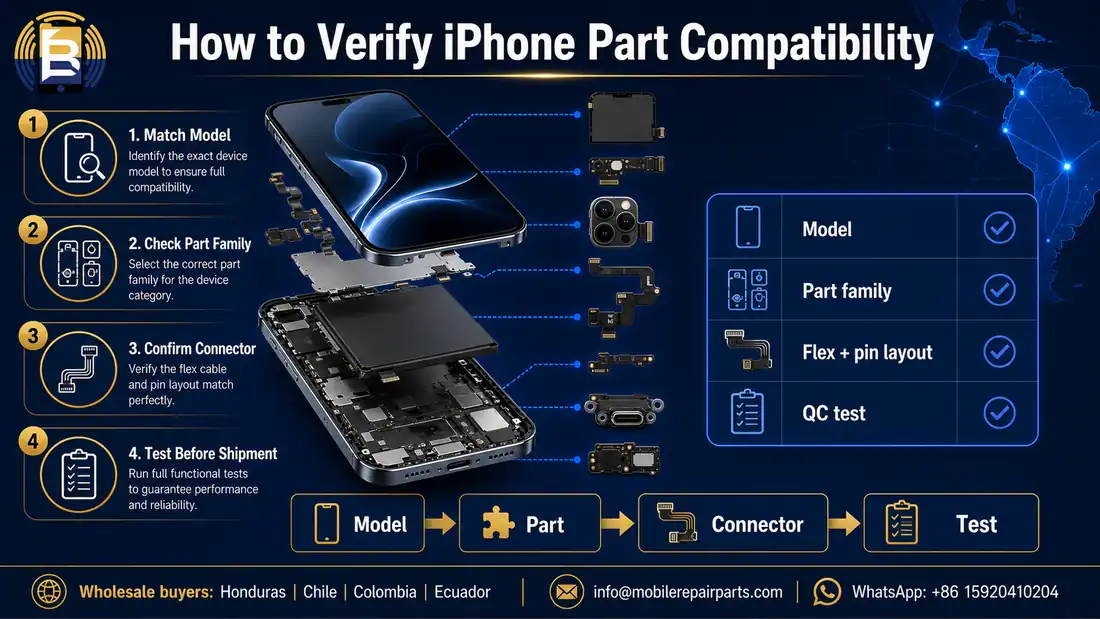
Step 1: Identify the exact device
Confirm the exact model using device settings, original packaging, model number, screen size, camera layout, connector type, and housing configuration. Do not rely only on the customer’s description or a product-family name.
Step 2: Compare the part against the original
Compare flex length, connector position, screw holes, brackets, camera openings, speaker mesh, battery connector, charging-port shape, wireless-coil position, sensors, and microphones.
Step 3: Test before final installation
For displays, test image quality, touch response, brightness, color, proximity sensing, and front-camera operation. For batteries, test charging, discharge, recognition, temperature, and physical condition. For charging assemblies, test charging stability, cable connection, data transfer, microphone, and antenna behavior where applicable.
Step 4: Document the result
Each wholesale batch should have a batch number, supplier SKU, model compatibility, quantity tested, test date, tester reference, pass, hold, or reject result, and warranty notes. This makes recurring problems easier to identify.
Latin America Wholesale Planning for Honduras, Chile, Colombia, and Ecuador
Latin American markets require flexible inventory planning because distributors may serve different repair shops, cities, and customer segments. The same model family can move through different channels with different SIM configurations, network expectations, packaging requirements, and customer budgets. Ask the buyer for the exact device model number and intended market before confirming the part.

Country-focused questions for wholesalers
| Market | Practical Planning Question | Recommended Inventory Action | Commercial Record |
|---|---|---|---|
| Honduras | Which model variants are common in the buyer’s service area, and is a physical SIM tray required? | Separate exact-model SKUs and include SIM configuration in the quotation. | Model number, buyer city, SIM requirement. |
| Chile | Are customers prioritizing premium replacements, value repairs, or both display quality levels? | Offer clearly labelled quality tiers with brightness, touch, warranty, and test information. | Quality grade, acceptance standard, warranty. |
| Colombia | Are distributors ordering mixed models for multiple repair shops and network environments? | Offer mixed-SKU cartons only with clear model, region, connector, and grade labels. | Model mix, quantity, regional variant. |
| Ecuador | What documentation, packaging, delivery, and warranty terms does the importer need? | Prepare invoices, labels, packing information, and tracking before dispatch. | Invoice, packing list, delivery terms. |
| Global orders | Which model identifier, connector generation, network requirements, and documents apply? | Use a region field in every SKU and request a sample when uncertain. | Country, model, compliance, sample result. |
Country names should not substitute for technical compatibility. Regional planning should be based on verified order patterns and confirmed model requirements, not assumed demand. Do not publish country-level sales, margins, returns, or conversion figures unless they come from validated company records.
Wholesale Quality-Control Checklist for iPhone Parts
Quality control should begin before shipment and continue through receiving inspection. The checklist should be visible to purchasing, warehouse, sales, and technical-support teams.
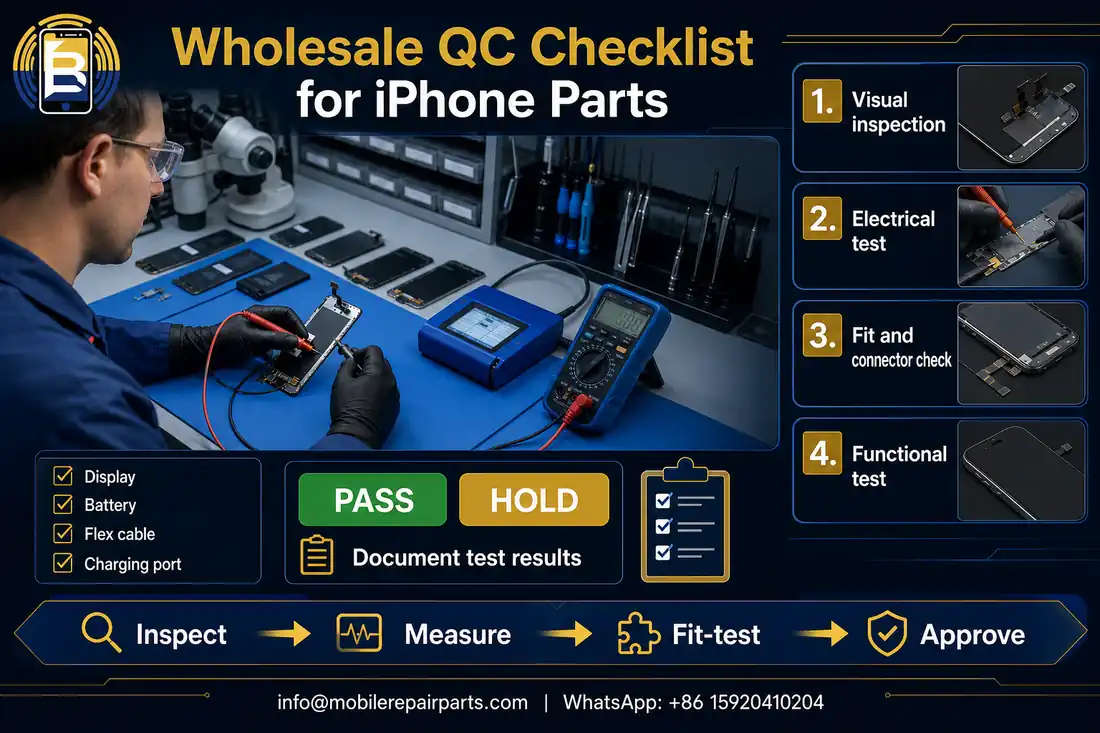
| QC Stage | What to Check | Pass Criteria | Action if Failed |
|---|---|---|---|
| Packaging inspection | Label, quantity, model, batch reference, and visible damage. | Correct label and undamaged packaging. | Place the batch on hold. |
| Visual inspection | Scratches, cracks, bent flexes, corrosion, missing components, or glass defects. | Clean and physically complete part. | Reject or request supplier review. |
| Connector inspection | Pins, socket alignment, flex condition, oxidation, and contact damage. | No bent, oxidized, or damaged contacts. | Reject affected units. |
| Functional testing | Charging, display, camera, audio, vibration, sensors, and wireless functions. | Function matches the written specification. | Separate failed units and record reason. |
| Compatibility check | Exact model, regional variant, connector, part type, and SKU. | Matches the purchase order and customer requirement. | Correct the label before sale. |
| Final packing | Anti-static protection, carton label, model separation, and export documentation. | Safe and traceable for international shipment. | Repack before dispatch. |
Use a documented pass-or-hold decision before parts enter saleable stock. For high-value components, sample testing from every incoming batch may be appropriate. Company-specific defect, return, margin, demand, and warranty metrics should be published only after validation from actual records.
How to Build a Compatibility-Safe Wholesale SKU
A clear SKU helps prevent errors between purchasing, warehouse, sales, and customer-service teams. A practical format is:
MODEL-PART-CONNECTOR-REGION-GRADE-TESTSTATUS
Recommended SKU fields
| SKU Field | Example Information | Why It Matters | Required Evidence |
|---|---|---|---|
| Device model | Exact iPhone generation and model number. | Prevents similar-model confusion. | Model reference or buyer confirmation. |
| Part type | Display, battery, camera, charging flex, housing, speaker, or coil. | Identifies the replacement category and test plan. | Supplier specification and product label. |
| Connector | Lightning or USB-C plus supplier part code. | Prevents charging-part mismatch. | Connector and flex inspection. |
| Region | Confirmed buyer country or regional variant. | Supports order accuracy and SIM or network planning. | Buyer country and model number. |
| Quality grade | Soft OLED, hard OLED, LCD, tested battery, or defined grade. | Sets customer expectations clearly. | Written quality criteria. |
| Test status | Sample passed, batch passed, held, or retest required. | Improves warehouse control. | Test record with date and tester. |
The exact SKU format can be adapted to the warehouse system, but the fields should remain consistent. If a supplier cannot state the exact model scope, connector details, quality grade, and warranty conditions, treat the item as unverified.
Internal Resources for iPhone Parts Buyers
Use this compatibility matrix together with the main iPhone Spare Parts 2026 guide to organize product sourcing, model-based inventory, quality-grade selection, regional order preparation, technician documentation, and warranty workflows.
Sources and Methodology
This guide uses publicly available technical and ecosystem information from institutional reports and official device-support documentation. Regional connectivity and mobile-industry figures are ecosystem indicators. They are not BETA sales, demand, profit, conversion, defect, warranty, or return statistics. Any future company-specific metric should state its definition, time period, sample size, and denominator and should be validated against actual analytics, wholesale orders, warranty records, product tests, and customer-country distribution.
Reference sources: GSMA Mobile Economy Latin America 2026, ITU Facts and Figures 2024, and official USB-C support documentation.
Final Takeaway
Successful iPhone parts wholesale depends on accurate compatibility control, not only competitive pricing. Identify the exact device model, confirm the regional variant, match the connector and internal layout, select the correct part category and quality grade, test the component, record the batch result, label the SKU clearly, and communicate compatibility limits honestly. This process helps wholesalers and technicians in Honduras, Chile, Colombia, Ecuador, and global markets reduce stock errors and complete installations with greater confidence.
For wholesale sourcing support and a tailored quotation, contact BETA through WhatsApp +86 15920410204 or email info@mobilerepairparts.com.
Frequently Asked Questions
How can I verify iPhone part compatibility before placing a wholesale order?
Confirm the exact iPhone model, model number, screen size, regional variant, connector type, internal layout, and part category. Then compare the replacement part with the original component and request a sample or batch test when necessary.
Are iPhone parts from similar models automatically interchangeable?
No. Similar-looking models may use different displays, batteries, cameras, charging flexes, housings, or sensor assemblies. Compatibility must be confirmed using the exact model and part specification.
Which iPhone models use USB-C connectors?
iPhone 15 and later models use USB-C connectors for charging and data connections. The complete charging assembly and internal flex still need to match the exact model.
What should wholesalers test before selling iPhone replacement parts?
Test the function relevant to each part, including display image and touch response, battery charging and discharge, charging-port stability, camera performance, microphone, speakers, vibration, sensors, and wireless functions where applicable.
How should iPhone parts be organized for Latin American wholesale buyers?
Organize parts by exact model, region, connector, part type, quality grade, frame status, batch number, and test status. Clear labeling helps distributors in Honduras, Chile, Colombia, Ecuador, and other markets avoid compatibility and fulfillment errors.