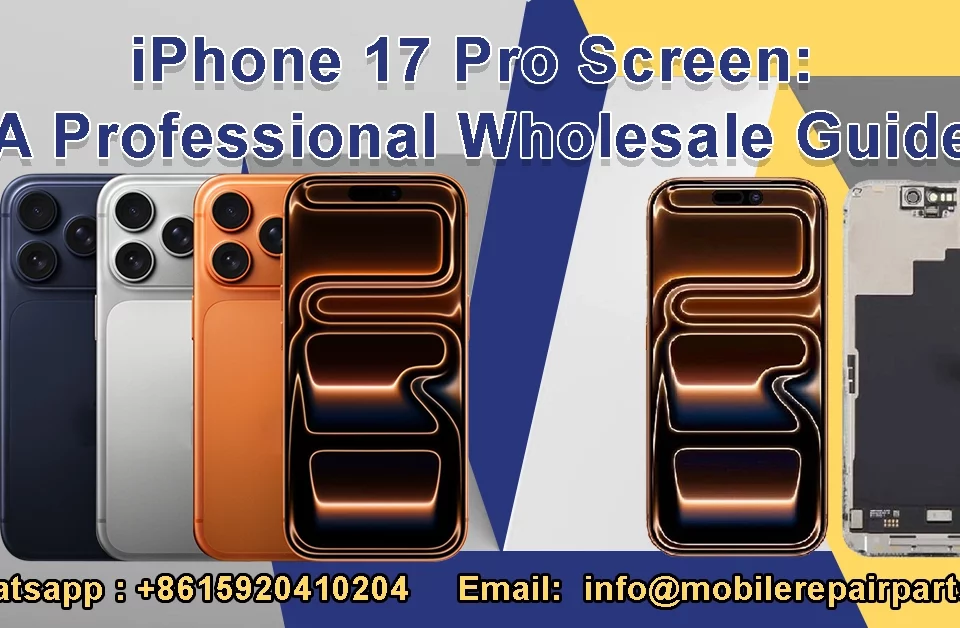


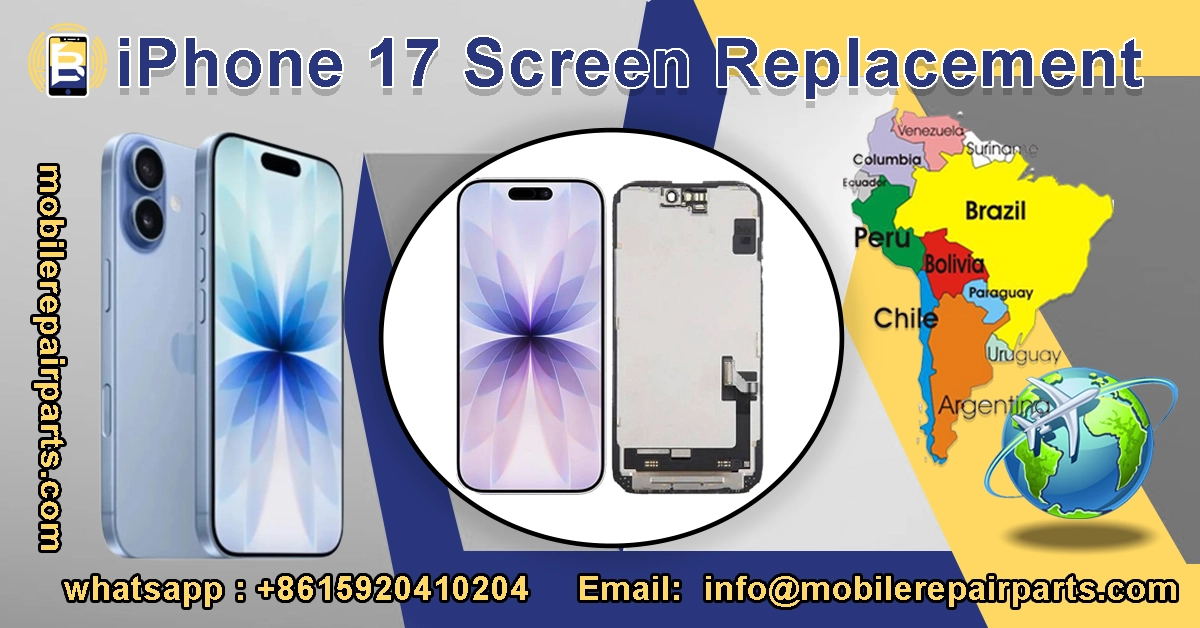
Replacing an iPhone 17 screen is not just a routine maintenance task; it is a delicate operation that determines the phone’s performance and the end customer’s satisfaction. Mastering this work is a trump card for Latin American distributors and technicians, ensuring higher profit margins, zero returns, and building a reputation for technical excellence in a market that demands only the best.
|
📘 Summary The iPhone 17 screen is no ordinary screen, but a 6.3-inch Super Retina XDR OLED panel with ProMotion 120Hz and high brightness suitable for outdoor use. Any replacement screen that does not offer the same performance will immediately appear to be of lower quality to the user. iPhone 17 screens represent a lucrative opportunity for wholesalers in Latin America, as users are keeping their phones longer and the refurbished phone market is growing rapidly. Instead of buying a new phone, many prefer to replace only the screen, making the demand for iPhone 17 screens continuous and profitable for wholesalers. |
🔍 Key Takeaways
|
Table of Contents
What is the iPhone 17 display and why is it important?
The iPhone 17 screen is the entire front assembly, including the OLED panel, touch layer, and front glass. Super Retina XDR technology provides vivid colors, deep contrast, and smoother motion thanks to a high refresh rate, making screen quality a key factor in the post-repair user experience.
What makes the iPhone 17 screen special from a repair perspective?
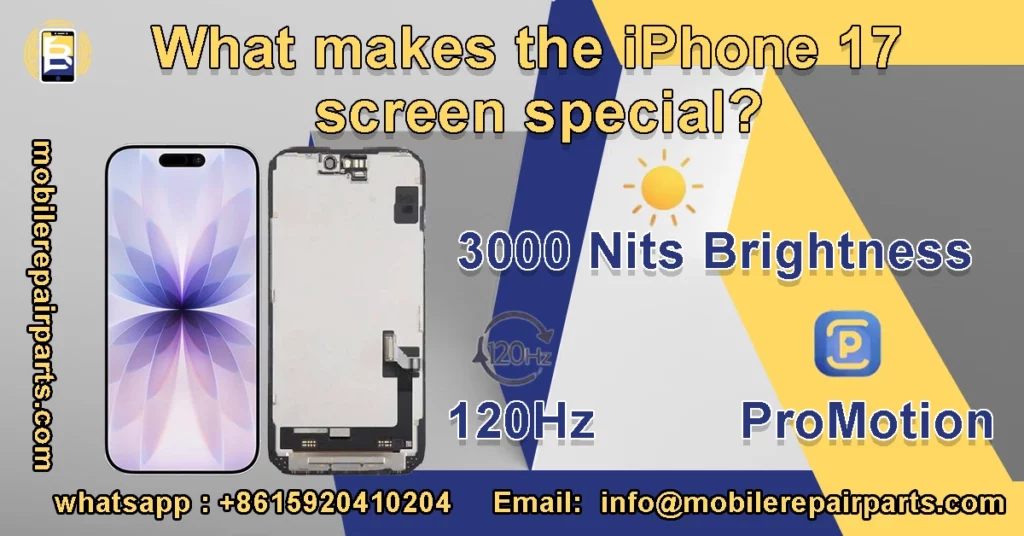
The iPhone 17 has a 6.3-inch screen with a refresh rate of up to 120Hz, making movement smoother and response faster. It also supports True Tone and Dynamic Island, so the replacement screen must match the original specifications to maintain the same display quality.
For technicians and wholesalers, the difference in quality is immediately apparent. Poor-quality screens suffer from lower brightness or inaccurate colors, which users quickly notice and which affects their confidence in the repair process.
How do iPhone 17 screen specifications affect replacement quality?
To choose an Apple iPhone 17 display suitable for wholesale or repair, it is necessary to understand the basic specifications and how they affect the user experience. Size and resolution: 6.3 inches, Super Retina XDR OLED, with FHD+ resolution of approximately 460 pixels per inch, ensuring clarity of text and elements.
- Refresh rate: Up to 120Hz, making scrolling and gaming extremely smooth.
- Brightness: Up to 2000–3000 nits outdoors, important for sunny climates.
- Protection: Ceramic Shield glass is scratch and impact resistant.
Any low-quality replacement screen may work, but the user will notice a decrease in brightness, color depth, and smoothness of movement. Therefore, many wholesalers prefer to focus on high-quality parts that match the original specifications rather than cheap options.
How should wholesalers in Latin America strategize for iPhone 17 screen inventory?

Wholesalers serving Latin America need a structured approach to inventory, as shipping times from China plus customs can easily stretch into weeks. Basic principles for iPhone 17 screen inventory:
- Focus first on fast-selling models: standard OLED screens for iPhone 17 with pre-installed frames and small parts.
- Maintain at least two levels of quality: high quality and medium quality, with clear labeling, to serve different segments of the repair shop market.
- Analyze the geographic distribution of demand: The needs of markets in capitals and major cities differ technically and price-wise from those in smaller regions and areas.
- Plan for reserve inventory for customs delays and seasonal peaks (Black Friday, Christmas, local shopping events).
Since the average smartphone replacement cycle in South America is around 3 years, screens remain in demand long after launch, especially for customers who keep their phones after the warranty expires. This makes the Apple iPhone 17 screen a long-term product, not just a short-term trend.
What should technicians check when receiving an iPhone 17 screen?

To ensure peak performance and avoid wasting time, a quality control (QC) check of the iPhone 17 screen must be completed before the phone is finally sealed. Follow these professional steps:
- Visual Inspection:
Glass integrity: Ensure that the screen is free of micro-cracks, dust under the glass, or any separation at the edges.
Cable integrity: Inspect the flex cables to ensure there are no sharp bends or exposed copper. - Functional Test:
Touch response: Test the touchscreen across the entire surface using a grid-style app to ensure there are no “dead spots.”
Brightness and colors: Test the brightness gradient and color stability on white, black, and gray backgrounds to detect any damaged pixels. - Feature Test:
Face ID and Camera: Ensure that the sensors and front camera are working accurately after the transfer.
True Tone: Check the response of the ambient light sensor and True Tone feature (if data transfer is supported).
What tools and environment are recommended for iPhone 17 Screen replacement?
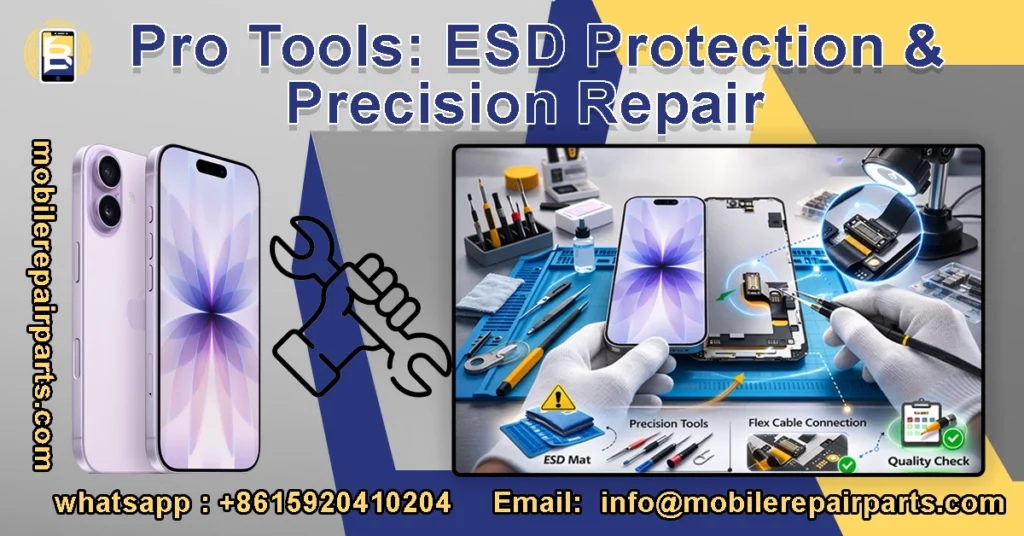
The iPhone 17’s delicate OLED screen requires a controlled working environment and professional tools to avoid damaging flexible cables or sensors. Here is the basic list:
- Disassembly and precision tools: High-quality screwdrivers (Pentalobe, Tri-point, PH000) to prevent screw wear, with suction handles and plastic opening tools to protect the frame from scratches.
- Heat management and adhesives: Use a precisely calibrated heat pad to safely soften the adhesive, with a UV curing device and compatible adhesives to ensure water resistance is restored.
- ESD protection: Anti-static mat and wrist strap; a mandatory step when handling sensitive OLED circuits to prevent silent electrical damage.
- Work environment and cleanliness: Work must be done in a dust-free area, as any particles under the screen will be considered a manufacturing defect by the customer, using microfiber cloths and medical alcohol to ensure the best adhesion.
What are the common mistakes when replacing an iPhone 17 screen?
Advanced OLED screens require careful handling to avoid damage. Here are the most common mistakes to watch out for to ensure the highest quality repair:
Removal stage mistakes:
- Uneven heat distribution: Heating one area intensely causes pixels to burn or internal components to be damaged.
- Using excessive force: Inserting opening tools too deeply causes data cables to be cut or the metal frame to be scratched.
- Sudden removal: Pulling the screen before the adhesive has completely dissolved can tear the vital sensor connectors.
Installation errors:
- Cable strain: Bending the flex cable at sharp angles weakens the copper tracks, causing the screen to malfunction later.
- Loose connections: Improper installation of connectors leads to touch response issues or lines appearing on the screen.
- Skipping testing: Turning off the phone before testing the camera, Face ID, and True Tone doubles the repair time if there is a malfunction.
How can technicians explain the difference in iPhone 17 screen quality to customers?
The best approach is to explain simply and transparently, focusing on what the customer will notice in everyday use:
- Use a simple, understandable example
You could say:
“There is a high-quality screen that provides the same brightness and colors as the original, and there is a cheaper option, but with less brightness and protection.” - Show the difference in a practical way: If possible, display two screens side by side. When customers see the difference in brightness and colors for themselves, the decision becomes easier.
- Explain the difference in warranty: Explain that high-quality screens come with a longer warranty and more stable performance, while cheaper options often have limited warranties.
- Link quality to user experience: Tell the customer that a better screen means clearer visibility in sunlight, more accurate colors, and a longer lifespan.
Are iPhone 17 screens compatible across different versions of the series?
Apple follows a technical pattern in the iPhone 17 series that prevents interchangeability between screens, with each model designed with unique specifications. Therefore, distributors and technicians must treat each model’s screen as a separate product to avoid costly supply errors.
Reasons for technical incompatibility:
- Size and resolution differences: Apple’s base model screen (6.3 inches) differs from other models such as the iPhone 17 Pro Max, which has a 6.9-inch screen, in terms of size and pixel density.
- Display technology differences: Apple’s Pro models rely on advanced LTPO panels, which means a radical difference in software definitions and flexible cable design.
- Connector distribution: Mounting points and connector locations vary from model to model, even if the screen size appears to be similar.
FAQs about iPhone 17 Screen replacement
Do iPhone 17 Screen replacements affect Face ID?
The iPhone 17 Screen itself does not contain Face ID; however, the front sensor assembly attached to the screen must be transferred carefully. Any damage or misalignment during this process can cause Face ID failure, so technicians must handle these components with extra care.
How long does it take to professionally replace an iPhone 17 screen?
The process takes between 30 and 50 minutes for experienced technicians, including time for inspection and final testing to ensure quality.
How can I verify if an iPhone 17 Screen has proper brightness and color?
Use test images (white, gray, black, and primary colors) and compare the replacement iPhone 17 Screen to a known good reference device. Check maximum brightness in sunlight and look for color casts such as green or blue tints, which indicate lower‑quality panels.
Can touch issues occur after replacing an iPhone 17 screen?
Yes, and the reasons are often due to the use of low-quality spare parts or not handling the flex cables with care during installation, resulting in poor responsiveness or loss of accuracy in certain areas of the screen.
The iPhone 17 screen is a significant profit opportunity for wholesalers and repair shops in Latin America, but success depends on selecting screens of consistent quality, clearly grading them by tier, and working with a supplier that provides reliable technical support.
Carefully selecting premium and mid-range screens reduces returns, increases customer satisfaction, and helps you build a strong reputation in the market. Proper installation and pre-sale quality checks also boost customer confidence and ensure better results.
If you are looking for high-quality iPhone 17 screens from specialized factories in China, with export services to Latin America, please visit: mobilerepairparts.com.