


A repair business can lose days when a supplier receives “iPhone screens and batteries, best price?” but has no model list, quantities, or quality requirements to quote against. Before sending your request, use our iPhone spare parts guide for wholesalers to identify the part families you need. This guide shows how to turn those needs into a clear request for quotation (RFQ), then check the offer before you commit to an order.
📘 Summary
Send a line-by-line parts list for a current, tailored wholesale quotation.
🔍 Key Highlights
- Include exact device models, part descriptions, quantities, and known quality or packaging requirements.
- Flag uncertain compatibility and ask the supplier to verify it.
- Confirm specification, availability, delivery assumptions, testing, and return terms.
- State the shipping destination and timing, especially for cross-border orders.
On this page
What should an iPhone spare parts wholesale quote request include?
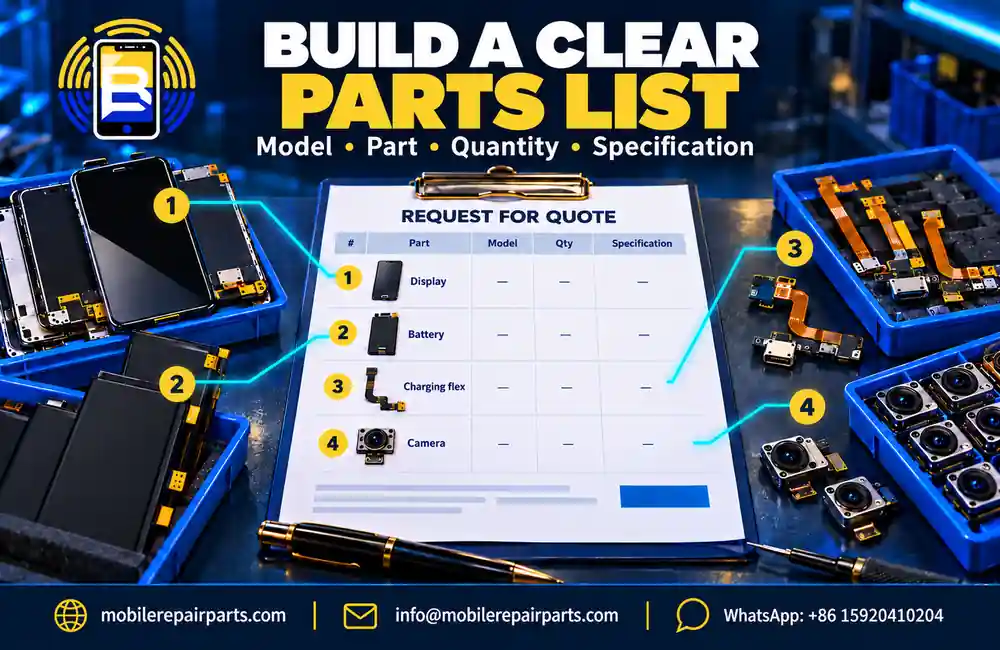
A useful RFQ lets the supplier identify each item and its intended destination without having to reconstruct your order from chat messages. Start with a simple spreadsheet or numbered list. One row should describe one part for one device model and one required specification. If two quality options are acceptable, request separate options so you can compare them clearly.
| Field | What to send | Why it helps |
|---|---|---|
| Device | Full iPhone model name; model number when available | Reduces confusion between similar model names and regional variants. |
| Part | Plain part name and assembly level | Separates, for example, a camera lens cover from a complete camera module. |
| Quantity | Units needed for each line | Lets the supplier assess the actual batch rather than a broad estimate. |
| Specification | Required grade, color, connector, or other essential detail | Prevents unlike products from being compared as if they were equivalent. |
| Evidence | Photo of the existing part or connector when the description is uncertain | Gives the supplier something concrete to verify before quoting. |
| Destination | Country and delivery city or postal area | Makes a shipping discussion possible without assuming one global freight cost. |
| Timing | Your required delivery window, if any | Helps separate urgent requests from orders that can wait. |
You do not need to know every technical detail before contacting a supplier. Mark a field “please verify” and attach a clear photo when you are unsure. A stated uncertainty is safer than an invented part number.
How to build the parts list without creating compatibility mistakes
Identify the device before naming the replacement part
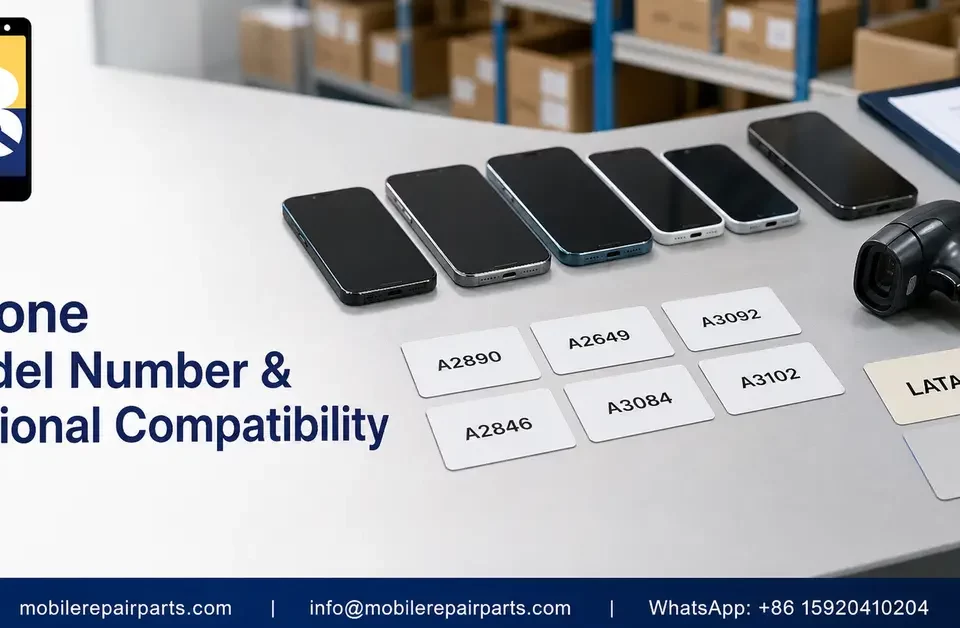
Use the full device name and, where possible, its model number. Apple explains how to locate the model number in Settings or on the device in its model-number instructions. Record the device information you actually checked; do not assume that a familiar marketing name settles every part-level question.
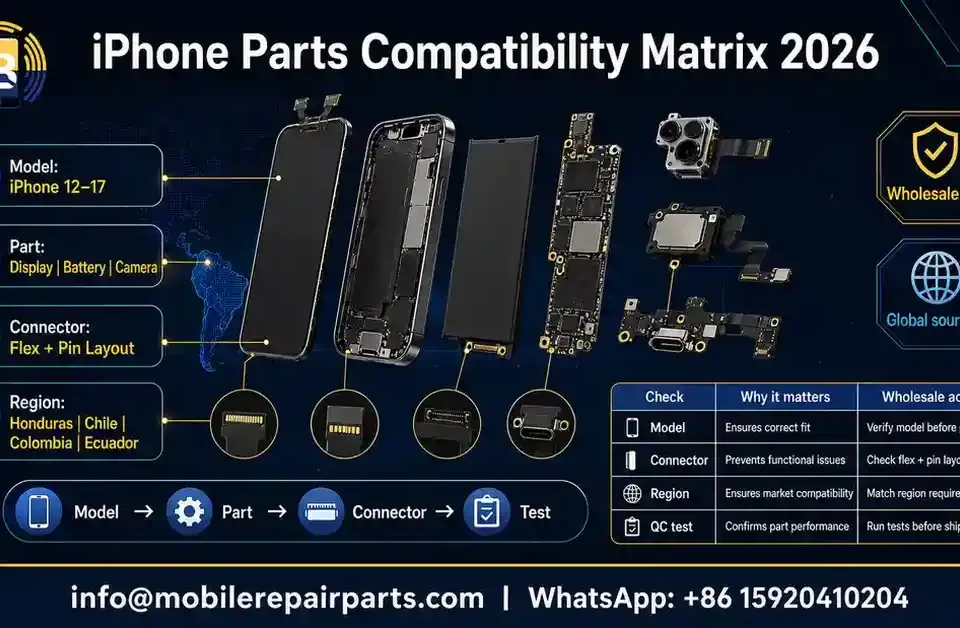
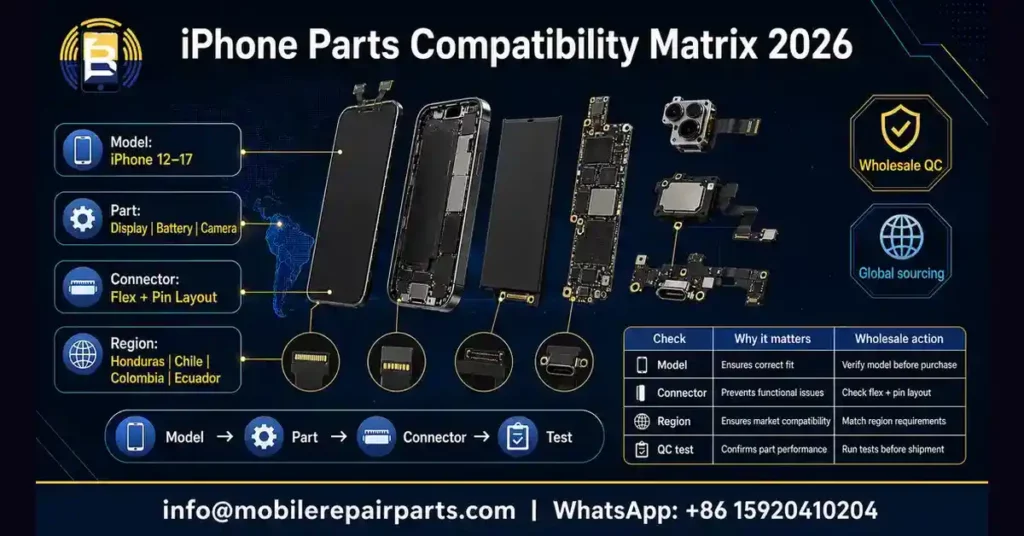
If a screen, battery, charging assembly, or camera is difficult to identify, compare it with the original part and ask the supplier to confirm the proposed replacement. Our iPhone parts compatibility matrix explains model, connector, and part checks in detail. For region-specific device identification, use the model number and regional compatibility guide. This RFQ article concentrates on communicating the result in a purchase request.
Describe the part at the right assembly level
“Camera,” “charging part,” or “screen” may refer to several different items. Say whether you need a complete assembly, a flex cable, a lens cover, a board, or another component. If you have a current SKU or a photo of the old component, include it. The supplier can then identify a mismatch before it becomes a returned order.
Avoid labels such as “original,” “OEM,” or “premium” unless both sides have agreed on exactly what the label means for that specific item. Ask for the actual offered condition and specification, and have each alternative quoted on its own line. The price is only comparable when the parts themselves are comparable.
Keep quantities and alternatives separate
State the quantity for each model and part. Do not combine several devices in one line such as “50 assorted screens.” If you can accept a substitute or a second grade, list it as an alternative, not an automatic replacement. This gives the supplier a way to quote what is available while preserving your approval over what is ordered.
For a mixed-model order, use a separate line for each model–part combination and request that the same distinction appears on the quotation and packing list. This reduces sorting work when the shipment arrives.
Copy-and-send RFQ template
The following message is a template, not a claim about stock, price, minimum quantity, or delivery time. Replace the bracketed fields with your actual requirements. Keep a copy of the final list so you can compare the quotation against the request.
- Subject: Wholesale quotation request — iPhone replacement parts
- Destination: [country, city or postal area]
- Requested delivery window: [date or “flexible”]
- Line 1: [full model] | [part and assembly level] | [required specification] | [quantity]
- Line 2: [full model] | [part and assembly level] | [required specification] | [quantity]
- Uncertain items: [photos attached; points to verify]
- Packaging or testing requirements: [only if applicable]
- Please confirm: item specification, unit and line totals, availability, any minimum quantity, quotation validity, shipping basis, estimated dispatch timing, and applicable warranty or return terms.
If you have multiple items, a spreadsheet is easier to review than a long image of a handwritten list. Photographs still help when a connector, housing color, or assembly is ambiguous. Keep images named by line number so they cannot be attached to the wrong item.
Why a current quotation is more useful than a fixed price list
People searching for an “iPhone spare parts price list” often need a budget. A static list, however, cannot confirm the price of their specific mix of parts at the moment they order. Quantity, part specification, availability, packing needs, shipping route, destination, and the requested timing can change the offer. This is a practical explanation, not an exhaustive list of pricing factors.
Ask for a written quotation tied to your exact line items and date. Check its validity period and request a refreshed offer if the list, destination, delivery terms, or timing changes. Do not treat a previous quote as a standing promise for a later order.
For international orders, the delivery rule and named place belong in the commercial terms, not in an assumption about what “shipping included” means. The International Chamber of Commerce’s Incoterms guidance explains that these rules allocate delivery obligations, costs, and risks between buyer and seller. Ask the supplier to state the applicable rule and place when it matters to your transaction; confirm freight, taxes, and import responsibilities separately.
How to review the quote before confirming your order

Compare the quote with your original request line by line. A low total does not compensate for a missing item, an unapproved substitute, or a different shipping basis.
- Match the item: Check the model, part name, assembly level, grade or condition, color, and quantity on each line.
- Separate the money: Check currency, unit price, line total, any extra charges, and whether freight is included or quoted separately.
- Confirm supply and timing: Look for available quantity, any minimum order requirement, dispatch estimate, and quote validity. Ask when a point is missing.
- Clarify delivery: Confirm the destination and the agreed delivery term or freight basis. Do not infer import charges from the product price.
- Record acceptance conditions: Ask how the parts are tested or described, how damage or mismatch should be reported, and which warranty or return terms apply to your order.
If one line differs, ask for a revised quote with the change visible. Approve the final version and keep it with the agreed specification and packing information. That record makes receiving and any later dispute easier to resolve.
Common RFQ mistakes that slow down an accurate offer
- Asking only for “best price.” Add the parts list and quantities so the offer has a defined scope.
- Combining models or grades. Separate them into lines, including acceptable alternatives.
- Guessing at compatibility. Share a device model number or component photo and ask for verification.
- Omitting the destination. Provide a country and city so freight assumptions can be discussed.
- Comparing totals with different terms. Compare the same parts, quantities, currency, and delivery basis.
- Using an old quote after changing the order. Request an updated version before confirmation.
The goal is a quotation you can actually purchase against, not a document that merely contains a number.
Send your iPhone parts list for a tailored quotation
Prepare the line-item list, attach photos for uncertain components, and state your destination. Then contact BETA with your parts request so the team can review the specific items and provide a quotation. If you are still deciding which part family to order, return to the iPhone spare parts wholesale guide before sending the list.
Frequently asked questions
Do I need a complete technical specification before requesting a quote?
No. Send the information you have, identify the details you are unsure about, and attach clear photos when useful. Ask the supplier to verify the unresolved point rather than approving a guessed part.
Can I request prices for several iPhone models in one message?
Yes. Put each model–part–specification combination on its own line with its quantity. This makes mixed-model orders easier to quote, approve, pack, and check on arrival.
Why can the final quote differ from a published parts price list?
A published list may not reflect your exact specification, quantity, stock position, destination, shipping basis, or timing at the time of request. A written quote for your current list gives you a clearer basis for an order.
Does a quote automatically include shipping, duties, and taxes?
Do not assume so. Ask which charges are included, which are separate, and which delivery rule and named place apply when relevant. Import responsibilities should be confirmed for the actual destination.
What if the supplier offers a different part or quality option?
Request it as a separate line showing the changed specification. Compare it with your repair or resale requirement and approve it explicitly before the order is confirmed.
Sources and editorial method
This article uses the site’s published parts and compatibility guides for internal navigation, Apple’s model-number instructions for device identification, and the International Chamber of Commerce’s Incoterms rules for international delivery terminology. It does not publish a price, claim a fixed shipping rate, or state an unverified company stock or warranty policy. The RFQ template and review checklist are practical editorial guidance, not a legal or customs determination.